How and where is Audi using artificial intelligence?
AI has become an integral part of many business areas
Artificial intelligence (AI) not only helps save time and money – it’s also a game changer across numerous domains. By deploying AI in a targeted way, Audi creates an environment that supports employees, enhances efficiency, and upholds high quality standards.
Audi is driving the adoption of AI forward – across all business units. Always with the goal of easing the workload for employees and becoming even more innovative and efficient.
“We are currently integrating AI wherever it is possible and makes sense and systematically scaling applications.”

Audi advances systematic data organization
To fully leverage AI across the company, efficient scaling is important, but having a well-structured data organization is even more crucial. It is the basis for making vast amounts of data usable and driving innovation forward.
The volume of data is especially high in Audi’s production environment: several hundred petabytes already exist. One petabyte is approximately 1,000 terabytes. Put another way, that’s enough storage space for around 223,000 movies in DVD quality. And thousands of gigabytes of new data are generated in the production environment every day. Audi is systematically unlocking the potential of this data with the continuous introduction of new AI tools. In production alone, Audi is advancing more than 100 AI initiatives at various stages of maturity. These are being gradually implemented and scaled to new use cases – and the trend is growing.
Rapid label analysis
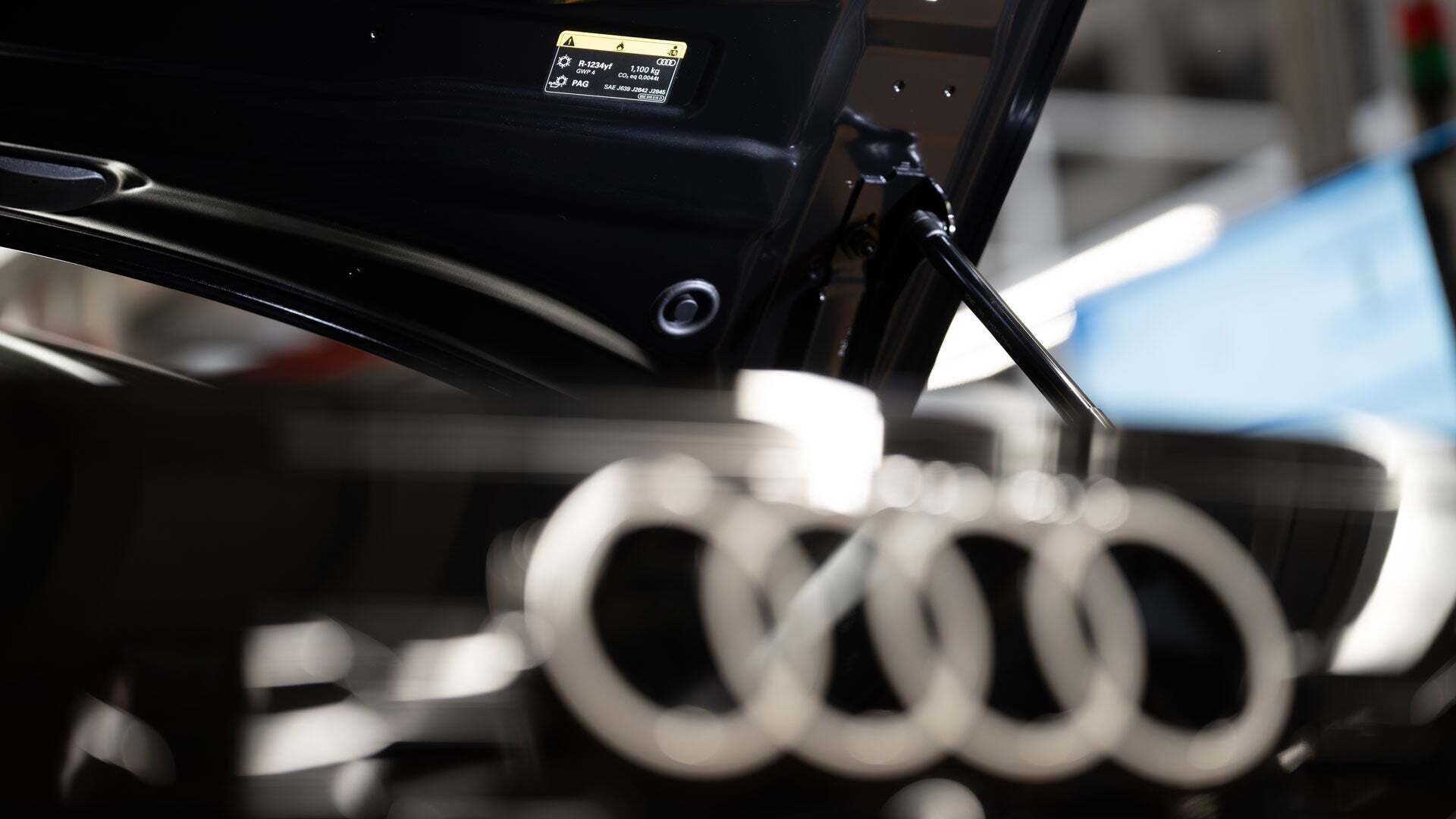
One example of AI application in quality monitoring at Audi is called IRIS (Intelligent Recognition and Inspection System). This image-processing AI checks labels on vehicles during assembly: Is the label – for example, the one indicating the correct fuel type – attached to the right component? Is it positioned correctly? Are the content and language correct? A camera captures images for real-time analysis, and the system alerts employees to any potential errors. IRIS thus reduces the need for laborious inspection work, saving employees valuable time.
AI-powered inspection: no spatter left behind
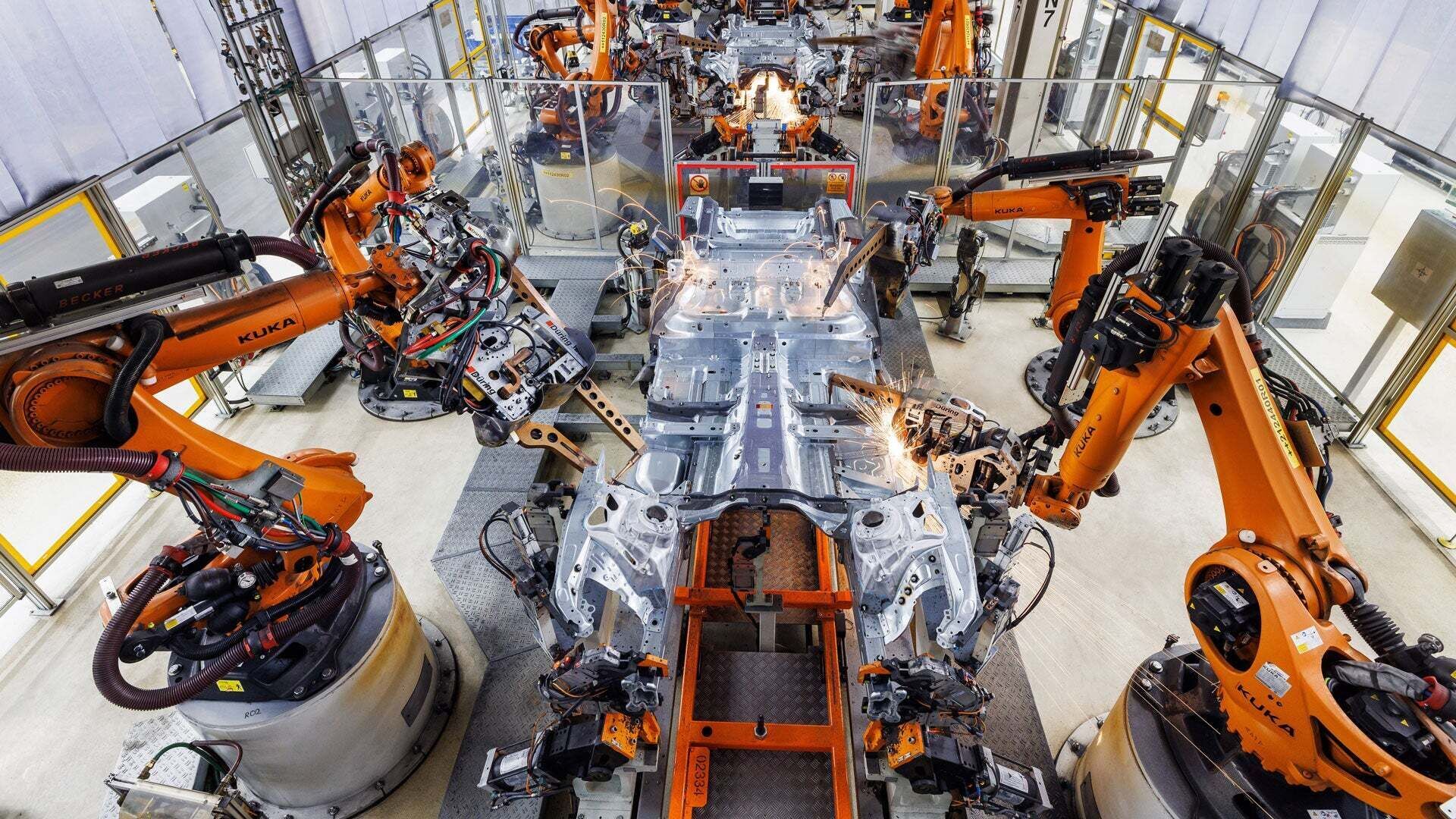
AI can also help in monitoring production processes. One example is the automated detection of so-called welding spatter – small material deposits that occur during welding on various sheet metal components in body construction. These spatter particles can damage components such as cables or compromise corrosion protection layers.
Until now, identifying these deposits has been a time-consuming task for employees. Now, an image-processing AI offers a solution. High-resolution cameras capture images at eight different points on the body component to reliably detect spatter. A light source marks the affected areas so that employees can perform targeted regrinding. In the next stage of automation, a robotic arm will take over the rework process.
Tender analysis up to 30 percent faster
Audi recently started utilizing AI to analyze bids as part of its tendering process. Few areas are as complex and time-consuming as tendering in production planning: Audi’s specifications alone can span 500 to 1,000 pages, with each supplier submitting a bid of more than 100 pages. When a single tender receives around 15 bids, Audi’s planners can be occupied for weeks.
To simplify and accelerate this process, Audi developed "Tender Toucan", an AI-powered tool. In the first step, it generates a list of requirements – based on the specification document – that must be addressed in the supplier’s bid. In the second step, the tool identifies relevant sections in the bid, compares their content with the requirements, and evaluates the degree of compliance. All the planning staff needs to do is upload all the documents into the tool and review the checklists. With "Tender Toucan", they can save up to 30 percent of their time.
The chatbot construction kit
The so-called LLM Blueprint is also designed to save time. It is a tool for implementing AI applications quickly and efficiently on a large scale. LLM stands for Large Language Models: powerful language models trained on vast amounts of data that form the basis for many popular chatbots like ChatGPT and Gemini.
Developed by an internal AI team at Audi in collaboration with Microsoft, the LLM Blueprint serves as a kind of modular framework for chatbot development. With it, the AI development team has laid the groundwork for fast, customized chatbot solutions across the entire company. This means that developers do not have to create new application ideas from scratch; they can build on components already developed for other use cases.

AI-powered creativity in design
AI can also support Audi employees in creative tasks. The AI-based software FelGAN – a proprietary development by Audi IT and Audi Design – generates a wide range of photorealistic wheel designs and can creatively combine existing ones. This gives design teams access to an almost unlimited pool of ideas, and they can also integrate their own sketches and photos into the system.
Using AI responsibly
Audi is committed to the responsible and compliant use of AI. This commitment is grounded in the Audi Code of Conduct, a foundational statement, a works agreement, a corporate AI policy, and a digital ethics framework. These documents define the ethical and regulatory principles that guide how AI is developed, used, and deployed at Audi.
The company is currently establishing internal processes to fully meet the requirements of the EU AI Act. The EU AI Act is the world’s first comprehensive legislation for AI systems. The aim of the European regulation is to establish clear rules for the use of AI, promote innovation, and ensure alignment with European values – protecting safety, health, and fundamental rights.
A key element of the legislation is AI literacy: the ability to understand, critically assess, and responsibly use AI. Audi offers a wide range of training opportunities to help employees harness the potential of AI while recognizing and mitigating its risks.

Partnering for progress
As a key technology marked by high complexity and rapid development, AI is already playing an increasingly important role today. By using AI strategically, Audi is creating a production environment that is not only more efficient and cost-effective, but that also meets the highest quality standards.
AI also supports product development, business processes, and workflows. In many cases, it can relieve employees of monotonous tasks and provide valuable support with complex challenges.
To fully leverage AI’s potential, Audi relies on strong partners, especially within the Heilbronn digital ecosystem. The term “ecosystem” refers to the alliance of companies, scientific institutions, and the Innovation Park for Artificial Intelligence (IPAI). The IPAI is set to become Europe’s largest AI network and will begin constructing a 23-hectare campus in 2025. Audi has been a member of the IPAI since 2023.
Events and awards: how Audi is sourcing further AI inspiration
Audi is leveraging additional formats to gather fresh ideas from the ecosystem and startup scene, assess potential collaborations, and expand its capabilities. The company is actively involved in key AI events such as the DeepRacer Cup, the Heilbronn AI festival, and the startup festival Slush’D. This year, Audi is presenting the Co-Innovation Award together with the organizer Campus Founders. The award promotes innovations in key business areas such as development, sales, production, and logistics – with a focus on AI. The winner will have the opportunity to test their product at Audi in a real-world setting.