
Sustainability management
Sustainable corporate governance not only paves the way for a future-proof society, but can also help to make companies more resilient. For Audi, aligning with sustainability criteria is a key lever for ensuring the company’s future viability and provides the opportunity to position itself clearly with respect to customers and the competition.
Ethical principles, legal provisions and internal policies on sustainability management provide the company with a framework for action. At the same time, regulatory developments need to be identified early on so that opportunities can be actively seized. The goal is to integrate sustainability effectively and efficiently into management structures and decision-making processes.
Implementing sustainability
To ensure the best possible impact on the environment, people and the economy, corporate structures have been created that allow defined sustainability goals to be tracked effectively based on the following key fields of action:

Vehicle efficiency
Fully electric Audi models impress with their efficiency. Customers experience this in many ways including high ranges and short charging times. Electric models from Audi therefore offer real everyday comfort. Contributors to this efficiency, for example, are the 800-volt architecture, an innovative powertrain as well as modern battery and efficient charge management. In addition, improved internal combustion engines with mild hybrid or plug-in hybrid technology reduce carbon emissions.
Circular economy
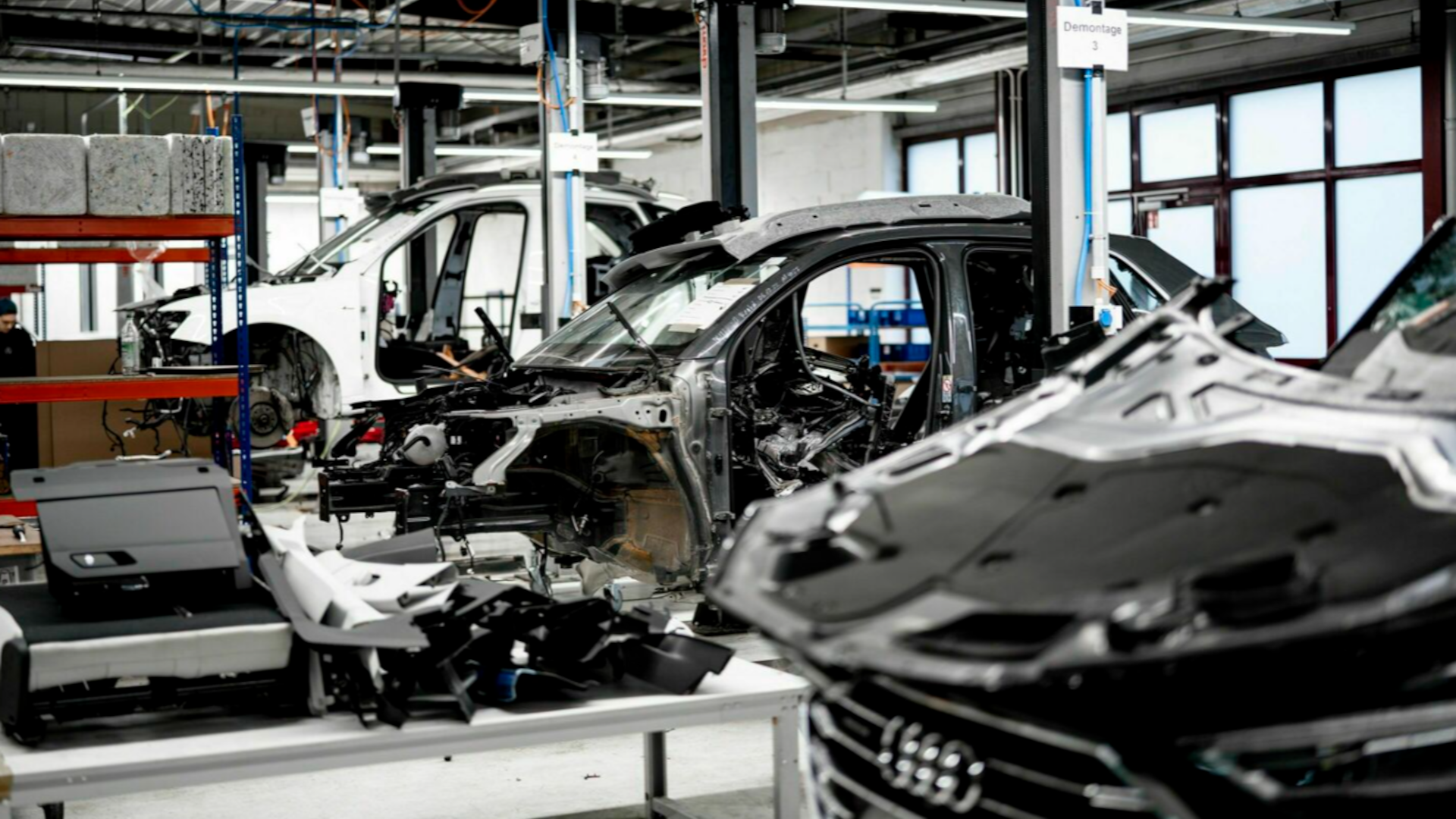
Audi focuses on the circular economy in line with the principles of rethink, reduce, reuse and recycle in order to prevent raw material shortages, conserve resources and act economically. Measures taken in this respect include recycling-friendly product development, target values for secondary material in new vehicles, resource-efficient alternatives to new parts and optimized use of materials.

Decarbonization
Audi wants to reduce CO₂ emissions throughout the life cycle of its models and along the value chain. One of the ways the company intends to do this is by electrifying the model portfolio.
Audi is expanding its target vision to include areas of exploration that will enable the company to react to new trends, regulatory developments or social requirements. These areas of exploration create scope to monitor potentially relevant topics early on, think ahead and, where necessary, incorporate these topics into strategic work practices. This means that the target vision for sustainability remains flexible and forward-looking.
Foundations for responsible action
Audi is strengthening its focus on sustainability by establishing fundamental principles across all topics. These provide orientation, support implementation of the Audi strategy and ensure a complete picture of sustainability – viable above and beyond the company and compatible with the expectations of internal and external stakeholders.
Employees
Audi promotes a corporate culture that supports diversity, strives for equality and ensures the social protection, security and health of all employees. In addition, the company encourages continuous learning and employee development as key factors on the shared path toward transformation, thus ensuring innovative strength and future viability.
Partners
Together with its partners, Audi sets standards for human rights, the environment, integrity and responsible management of raw materials. The company focuses on continuously improving sustainability, especially when handling critical raw materials. Close collaboration with partners within the supply chain ensures that ecological and social responsibility is exercised along the value chain.
Society
As part of society, Audi is involved in various projects and initiatives, for example through the Audi Environmental Foundation. The goal is to provide positive impetus above and beyond core business and comprehensive support for sustainable developments.
Managing sustainability
It takes the collaboration of all stakeholders – within and outside the company – to make progress in the focus topics.
Internally, the Sustainability Steering Model (SSM) ensures targeted collaboration on the topic of sustainability, while at the same time acting as the interface for coordination with the Volkswagen Group and anchoring sustainability topics in corporate processes. In addition, it monitors performance in the key fields of action.
The Sustainability Council is the central entity. It organizes the flow of information, networks projects and prepares decisions, while promoting regular exchanges between the specialist areas and the sustainability department.
Stakeholder dialogue as a source of innovation
Audi is committed to open dialogue with its stakeholders to promote sustainability through collaboration. To ensure successful collaboration, Audi identifies relevant stakeholders and creates formats for dialogue on sustainability topics. Audi transparently communicates the progress made on an ongoing basis, thus fostering trust and providing important impetus. Through continuous dialogue, the company is able to consider the different interests of stakeholders in its decision-making and strategy processes.
Management approach

Contact
Do you have questions or comments on the topic of sustainability? Write to us at sustainability@audi.de. The team will be happy to help.