More than seven times around the world – with one battery
02/24/2026

Does this sound familiar? You just put fresh batteries in the device and now they’re dead again. Strange, you’re sure you charged the batteries! You wonder what the reason is, but it seems pretty obvious: aging.
More than just range: Audi HV-batteries are designed to last
For Audi, only a system that delivers long-term performance meets the standards of quality and everyday usability. When it comes to developing batteries, Audi therefore not only focuses on energy density for long range and charging capacity, but also on the life cycle of the high-voltage (HV) battery.
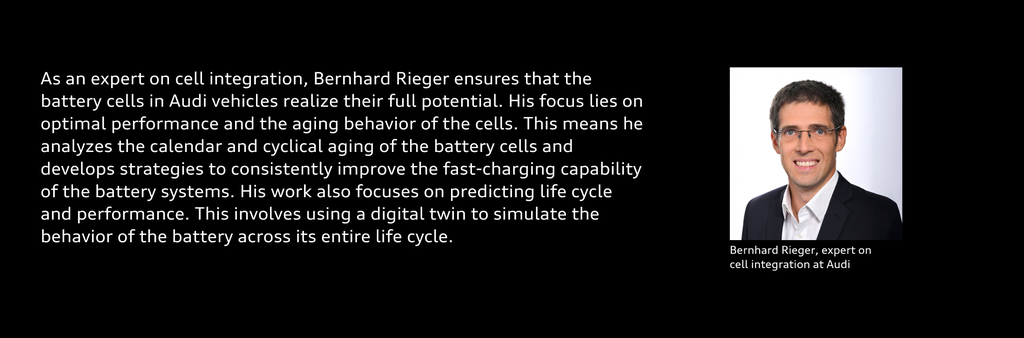
“We believe in thorough research, extensive testing and use of intelligent technologies to design battery systems that stand the test of time,” says Bernhard Rieger, Development Modules/Cells HV Energy Storage Systems.
As a premium brand, it’s important for Audi to ensure the best possible performance throughout the entire life cycle. Customers should not only benefit from a long range in the beginning, but should be able to expect a product that is reliable and offers high performance in the long term.
Bernhard Rieger, expert on cell integration at Audi
Long service life as an important guiding principle
The life cycle of the high-voltage battery is a defining characteristic of an electric-powered vehicle.
The Audi battery testing center* therefore focuses its development efforts on integral optimization of the cell and module properties. The objective is to achieve a good balance between long service life and range and fast charging capability. Audi knows that all three are crucial for ensuring a lasting, positive driving experience. All three must be in harmony to ensure real everyday usability.
Growing old – the right way: types of cell aging
The life cycle of a high-voltage battery is largely determined by aging processes within the lithium-ion cells. A deep understanding of the underlying chemical and mechanical operating principles is essential in order to selectively influence and optimize these processes. “We basically differentiate between two types of aging: cyclical aging, caused by regular charging, and calendar aging, which progresses regardless of use when the battery is inactive,” explains Bernhard Rieger. “At Audi, we consider it very important to thoroughly understand and manage both aging paths, so that we can ensure the best possible service life and performance of the HV battery throughout the entire vehicle life cycle.”
Types of aging
Cyclical aging
This type of aging results from regular operation – so from repeated charging and discharging of the battery. A charging cycle comprises one complete charge and discharge. Audi tests cyclical aging at cell as well as module and battery level. Different charging strategies are used here – such as fast charging and normal charging – as well as realistic driving scenarios, to reflect the stresses in everyday life as accurately as possible.
Calendar aging
A battery ages, even when idle, regardless of vehicle operation. Calendar aging is a chemical process in which the cell loses capacity over time – even when the vehicle is not in motion. Aside from the cell chemistry used, the speed of this aging process largely depends on the state of charge and temperature of the cell. Higher temperatures and states of charge accelerate the chemical reaction and therefore also the loss of capacity.
Seven times around the world – with one battery
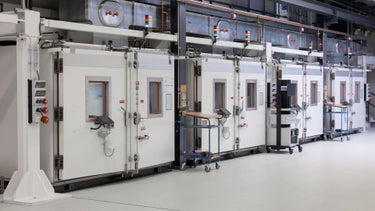
Audi performs extensive test procedures at its battery testing center in Gaimersheim* in the course of developing its high-performance and sustainable HV battery systems, testing and analyzing components under realistic conditions.
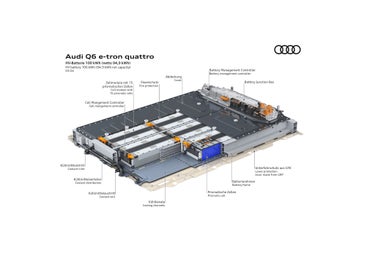
“The first tests are carried out at cell level and cover everything from cell modules to the complete battery unit. A cell module at Audi typically consists of 12 to 15 individual cells. These modules are then assembled into complete battery systems – such as in the PPE battery of the Audi Q6 e-tron, which comprises a total of 12 modules,” explains Bernhard Rieger.
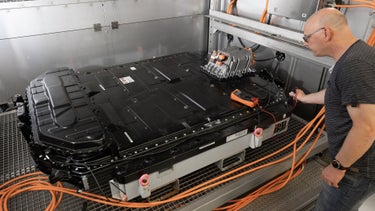
In the Audi battery testing center*, both individual cells as well as modules and complete battery systems can undergo comprehensive test cycles, during which their life cycle is analyzed. In the final development phase, HV batteries are tested over distances of up to 300,000 kilometers – roughly equivalent to orbiting the Earth seven times. This is followed by a detailed analysis of the battery status.
Thermal management that thinks ahead – a battery lifetime
“Another critical factor is the thermal management of the battery, which is controlled by the battery management system and likewise tested in Gaimersheim,” says Bernhard Rieger. “Audi is very familiar with the thermal limits of the cells and ensures that the HV battery always operates in the optimal performance window in different temperature ranges.”
The tests cover a broad temperature range of –30 to +60 degrees Celsius, thus replicating all real-life customer scenarios. Bernhard Rieger: “Aside from the physical tests, these conditions are also virtually simulated so that the HV battery can be optimally adjusted under all relevant ambient conditions.”
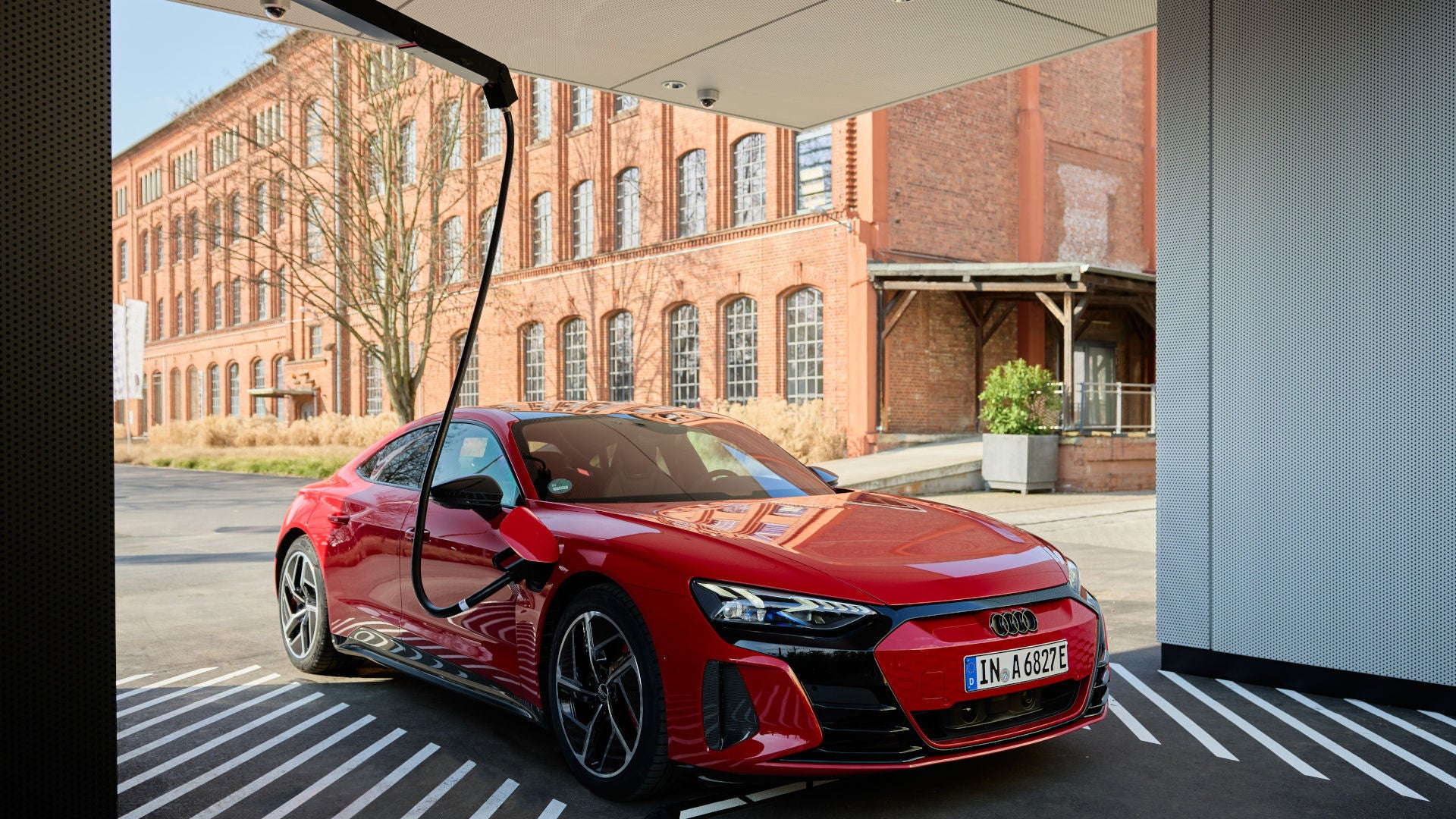
Customers can see the result of this work by Audi developers in the predictive thermal management of the Audi A6 e-tron on the Premium Platform Electric (PPE). This is an important aspect for the charging performance and also the long service life of the HV battery. The system uses the data from the navigation input, the route being driven, the departure timer and the customer’s usage behavior to calculate the need for cooling or heating in advance, as well as to provide this both efficiently and at the right time. If a customer is driving to a fast-charging terminal on the planned route, the predictive thermal management prepares the DC charging process and cools or heats the battery so that it can charge faster, thus reducing the charging time. If there is a steep grade ahead, the thermal management adjusts the HV battery’s temperature by appropriate cooling to prevent a higher thermal stress.
If the customer provides no information from which predictive data can be derived, a standard algorithm regulates the HV battery’s thermal management.
The sophisticated PPE thermal management also ensures efficient post-conditioning and continuous conditioning. A function is provided to monitor the battery temperature over the vehicle’s entire life cycle so that the battery is kept in the optimal temperature range even when the vehicle is not moving – for example in the case of hot outside temperatures. This measure also contributes to improved battery aging.
Long service life? The facts speak for themselves
Audi provides a guarantee of eight years or 160,000 kilometers on selected components of its fully electric models – with the assurance that the battery will retain at least 70 percent of its original capacity over this period.* In practice, however, there is evidence that the actual capacity is significantly higher: Real-world data shows that the battery capacity still averages around 89 percent after 160,000 kilometers. This underscores the high quality and long service life of the HV battery systems.
Responsible battery technology
Audi is committed to HV batteries with consistently high performance and intelligent modularity in its fully electric models. In addition to a long-term warranty, the development strategy focuses in particular on the actual life cycle and the possibility to selectively repair individual components.
The reparability of the battery is an important aspect for Audi. If a defect occurs over the course of time, the entire battery system does not necessarily have to be replaced. Audi believes in designing modular battery systems, which allow individual cell modules to be selectively replaced – comparable to replacing an individual component.
This modular design was already a central development objective with the Audi e-tron* and will also be consistently implemented in the new models such as the Audi Q6 e-tron and the Audi A6 e-tron. Not only does it enable cost-effective repairs, it also contributes significantly to sustainability, since functional components are preserved and resources are conserved.
Battery life cycle: less stress, more performance
The life cycle of a HV battery depends not only on the technical design and quality of the components – the behavior of the vehicle user also plays an important role. Similar to humans, stress has a negative effect on the health of the battery. The key is to understand what stress means in this context. And then to respond accordingly!
Audi therefore actively helps its customers to preserve the long-term stability and performance of their HV battery through clever charging behavior.
Two tips for preserving the performance of a HV battery:
- A permanently high state of charge represents a significant stress factor. If a vehicle is always fully charged again after short journeys or parked with a fully charged battery over a longer period of time, this can put pressure on the cell chemistry and negatively impact the capacity in the long term. To address this, Audi offers a battery care function: When activated, the state of charge is automatically limited to a maximum of 80 percent – an effective way to relieve strain on the HV battery in everyday use.
- High temperatures and frequent and exclusive fast charging can also accelerate battery aging. While the Audi HV battery systems are designed to meet these requirements, mindful charging behavior can help to protect the battery and slow down the aging process.


.jpeg)