Stakeholder Management
An honest assessment and an external perspective are essential for the continuous development of Audi’s sustainability strategy. Engagement with relevant stakeholders* therefore plays a central role. We enter into dialogue with them at various levels and thus receive important impetus for our long-term strategic sustainability work.
Audi wants to use various stakeholder management tools (see infographic) to learn about the interests and needs of its stakeholders* in detail. With this knowledge, the company can take even better account of social and societal requirements.
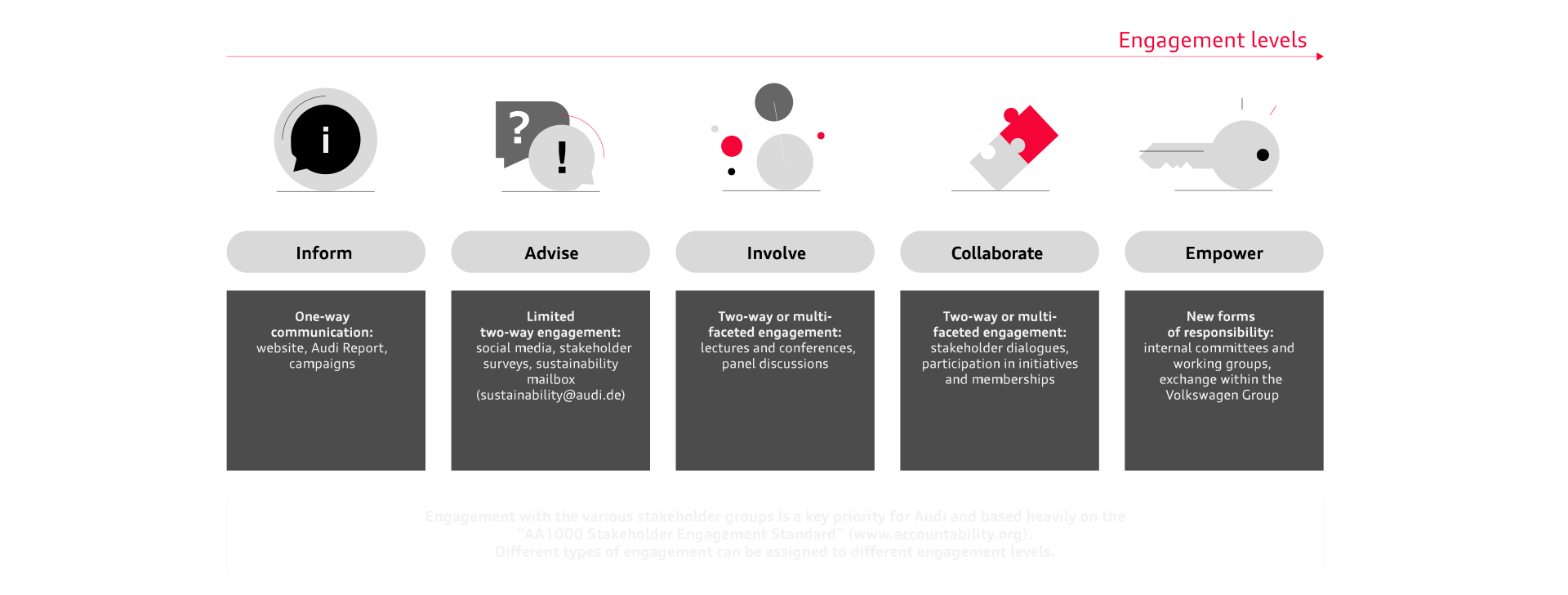
Stakeholder engagement: five steps for optimal stakeholder involvement.
Stakeholder engagement: five steps for optimal stakeholder involvement.
Targeted exchange
In addition, Audi uses different dialogue formats and one-to-one discussions to find out what motivates stakeholders. The company tries to find the right format for stakeholders depending on the topics addressed. These include dialogue formats and one-to-one discussions as well as multi-stakeholder events.
The objective of the exchange is, firstly, to expand and maintain the stakeholder network; secondly, a focus on content to increase ESG performance and, thirdly, to strengthen stakeholder acceptance of the transformation path that Audi is pursuing.
Appreciation, respect and trust form the basis for honest feedback and fair collaboration. Audi strengthens this through proactive communication on the one hand, and through transparency with regard to the results on the other.

Stakeholder dialogue on circular economy at Audi, 2025.
Constructive dialogue
What type of feedback does Audi hope to get from the dialogue formats? What helps move the company forward? What is the “outside-in perspective” on issues? What suggestions do the experts have? Audi wants to learn, examine perspectives, gather suggestions and build trust.
Audi in dialogue: The company uses regular dialogue events and conferences to actively involve its stakeholders. This approach enables Audi to promote an intensive, ongoing exchange about strategically relevant topics.
Strengthening trust
Continuous dialogue with our stakeholders is an integral part of sustainability work at AUDI AG. Through dialogue-led formats, Audi provides an opportunity to bring together different perspectives, openly address expectations and develop common solution approaches. The opinions and ideas contributed by the relevant stakeholder groups – from politics, business, science and civil society – provide important guidance for continuing to develop our sustainability activities, while strengthening mutual trust at the same time.
A key objective of this commitment is the development, maintenance and expansion of a resilient stakeholder network. This includes specialist meetings, plant visits, podium discussions, political dialogue formats as well as association and committee work. These varied interactions provide a clear picture of expectations regarding relevant topics, which helps Audi to focus on strategic priorities and address operational challenges at an early stage.
The dialogue formats outlined here are examples of this collaboration. They show how Audi involves key stakeholders, learns from their feedback and systematically incorporates their suggestions into projects and strategic advanced developments.
Stakeholder interactions in figures (2025)
stakeholder dialogues by or with the involvement of Audi
top topics: sustainability in the supply chain & human rights, electric mobility, social and ecological responsibility at the production sites
international dialogue events (including in Belgium, Mexico, Hungary, Turkey, Scotland)
ESG engagement made measurable: more key figures from the areas of Environmental, Social and Governance can be found in the Audi Report 2025.
Engagement at a glance: examples of contact with stakeholders over the years
2025
Stakeholder dialogue on fleet & sustainability
In October 2025, Audi engaged with company representatives in order to comprehensively assess customer requirements for companies as well as the issue of sustainability and data and product needs. During the exchanges, the regulatory requirements for fleet customers in the area of sustainability were categorized and both potential for cooperation and barriers to switching to electric mobility were identified.
What became clear was that sustainability is increasingly becoming a defining brand attribute – combined with clear expectations for transparent sustainability data. Moreover, the participants discussed key operational pain points as well as strategic future topics and innovation approaches.
The importance of following up results in a structured and organized manner was emphasized – together with recommendations from stakeholders to include the fleet perspective to a greater extent in the future in the development of sustainability activities.
Dialogue formats for the circular economy
In the spring of 2025, Audi engaged with representatives from along the automotive value chain to gain a deeper understanding of how stakeholders interact with each other in the context of the circular economy. Key challenges in relation to the recirculation of end-of-life and damaged vehicles, requirements in respect of Design for Circularity and necessary validation processes were discussed and potential forms of collaboration explored. In addition, the Act4Impact Circular Economy Day took place during which specific use cases were analyzed, taking into account regulatory trends, and recommendations for Design for Circularity were derived. The hands-on Design for Circularity workshops focused on strategies for remanufacturing and recycling based on examples of key parts such as headlights or bumpers, supplemented by insights from the Ellen MacArthur Foundation.
Both formats clearly demonstrated how crucial it is to involve external perspectives early on as well as the importance of continuous collaboration along the entire value chain. The results of both dialogues feed into the continued development of AUDI AG’s target vision of the circular economy – with particular reference to closing the loop, technical conformity and offering products that appeal to customers – and they are also used to identify measures and further accelerate transformation toward a functioning circular economy.
Audi Act4Impact Week
As part of the 2025 Act4Impact Week, Audi bundled key sustainability topics relating to the supply chain into practical online and in-person sessions for suppliers and employees. The goal was to create a common understanding of evolving requirements along the value chain and to raise the visibility of sustainability activities. The initiative focused on topics such as the circular economy, decarbonization, water management, biodiversity, raw materials management and human rights due diligence obligations. The sessions delivered in-depth knowledge, provided valuable input for achieving sustainability targets and addressed selected suppliers – for example in the area of water stewardship. The week therefore played an important role in effectively implementing sustainability measures along the value chain.
Stakeholder engagement as a central pillar of human rights work
The involvement of relevant stakeholders is a central element of human rights work at AUDI AG. In 2025, representatives from NGOs, science, business and associations engaged in a dialogue with Audi about how human rights work can be effectively organized even in times of economic challenges and decreasing regulatory requirements. The goal was to develop jointly supported approaches.
As part of the local initiative, Audi México conducted its own stakeholder dialogue together with the Human Rights Officer of the Audi Group, which focused on local human rights challenges. Regional risks were identified and fields of action established in cooperation with the German Embassy, NGOs, suppliers and trade unions.
AWS Global Water Stewardship Forum
During the 2025 AWS Global Water Stewardship Forum, the Alliance for Water Stewardship brought together international experts from politics, business, science and civil society to discuss current and future developments in sustainable water management. Audi was actively involved in the exchange on regulatory developments and issues relating to helping shape national and global water policies. Attention also focused on the economic importance of water, innovative financing approaches for water projects and the interlinking of water and climate strategies. Best practices – including insights into the Audi Water Stewardship Program – ensured a practical focus to the dialogue.
The exchange highlighted the strategic relevance of water as an entrepreneurial asset and the importance of collective action along the value chain. The insights gained and the external feedback are incorporated into the enhanced development of the Audi Water Stewardship Program and the strategic sustainability work of the company.
The Group Sustainability Forum – power & mobility
In 2025, Audi worked together with different stakeholder groups to address the issue of rising global demand for electricity – among other reasons, because of AI, data centers and growing digitalization – and the resulting dependencies. Based on various future scenarios, the potential impact on electric mobility was analyzed and opportunities, risks and key challenges for different stakeholders, including OEMs, customers and society, were discussed. The interdisciplinary exchange highlighted the importance of closer integration of energy and mobility strategies for creating more resilient and sustainable development of electric mobility. Findings will flow directly into the further development of the Audi sustainability strategy.
2024
Stakeholder dialogue on human rights
Audi deals intensively with human rights risks and challenges at various stages of the value chain. Motivated by the goal of understanding and improving the human rights situation along the supply chain, another stakeholder dialogue on human rights was held in Berlin on November 14, 2024.
Representatives from administration, science, industry and civil society exchanged views with relevant AUDI AG departments on the topic of “The inclusion of rights holders – between ambition and reality.”
The practically relevant and factually informed discussion highlighted where there are still barriers to the sustainable integration of stakeholder groups in processes, but also showed which formats are already successful today. It was agreed that there are no hard and fast rules for effective inclusion. Successful solutions are always context-specific, depending on the project, region and people concerned. Building trust between the players involved and the willingness to listen in order to understand better and tackle problems comprehensively are key. The Four Rings are continuing to work on this together with partners.
Sustainability in the supply chain
The joint implementation of environmentally relevant requirements in the supply chain requires cooperation between companies, suppliers and local stakeholders. In the area of decarbonization and the circular economy, Audi held around 40 workshops with suppliers in 2024. The findings helped to further sharpen the goals and roadmap for decarbonization and the circular economy in the supply chain. In addition, Audi has trained over 500 suppliers to prepare them for the upcoming requirements in the area of CO2 reduction and recycling.
In the area of water stewardship, Audi is pursuing a risk-based approach in order to take account of regional differences in water availability. In a pilot project launched in Mexico in 2024, suppliers were trained to promote sustainable water management in the long term. In workshops in November and December 2024, local water risks were analyzed, suitable measures discussed and recommendations for future action derived.
Greentech Festival
As part of the Greentech Festival 2024, Audi led a boot camp workshop that brought together 35 participants from various stakeholder groups. Start-ups, communication experts, NGOs and scientists were among those represented.
The dialogue had three central themes:
- Sustainable brand reputation: How does the sustainability reputation of a brand influence overall perception and decision-making processes?
- Sustainable communication: How can companies communicate sustainability during the consumer’s online research and purchasing process?
- Visible sustainability: Does sustainability have to be visible to customers at physical points of contact such as showrooms?
The stakeholders communicated several important concerns and messages to Audi: Brands play a key role in building trust, communicating visions and educating people about sustainability. Consistency and transparency in the messages – throughout the entire customer journey – are essential. Sustainability, however, is not yet a key argument in the mass market. The goal is to create fascination through innovation. The results of the dialogue were presented internally in various sustainability committees and will be incorporated into future product and brand communication.
“We build trusting relationships with our stakeholders and take account of their feedback in our strategic alignment in order to promote social and ecological progress together. We communicate our transformation process regularly and transparently.”
Dr. Johanna Klewitz, Head of Sustainability Strategy at Audi

Participation in external initiatives and organizations
Participation in external initiatives and organizations
Audi is involved in various initiatives, associations and working groups to discuss ecological, economic and social topics in collaboration with stakeholders. The selection of the following examples is based on the key focus areas of sustainability. The depth and effectiveness of this commitment are demonstrated, among other things, by these activities:
Aluminium Stewardship Initiative: Meanwhile Audi’s membership in the Aluminium Stewardship Initiative (ASI) dates all the way back to 2013. The ASI came about as a result of various stakeholders in the aluminum industry joining forces. The aim behind the initiative was to create greater sustainability and transparency in the aluminum sector and to promote the responsible extraction, processing and use of aluminum. Audi was the first automotive OEM in the world to attain an ASI Performance Certification and ASI Chain of Custody Certification. The “Chain of Custody” certificate awarded by the Aluminium Stewardship Initiative was bestowed again in 2024. The “Performance Standard” was recertified in 2025.
UN Global Compact: In March 2022, after an interruption, Audi rejoined the UN Global Compact, the world’s largest initiative for sustainable corporate governance. This membership in one of the most active platforms for dialogue among industry, civil society and politics is an important pillar of stakeholder management for Audi.
Alliance for Water Stewardship (AWS): In 2023, Audi became the first premium automobile manufacturer to join the Alliance for Water Stewardship (AWS). This global coalition of companies, NGOs, and the public sector is committed to the responsible use of water resources along the value chain. The AWS Standard is an internationally applicable framework for companies and organizations, aiming to ensure that water is used as efficiently as possible while taking into account all relevant stakeholders in the respective catchment area.
Ellen MacArthur Foundation: Since the beginning of 2025, AUDI AG has been a member of the Ellen MacArthur Foundation, a nonprofit organization dedicated to promoting the circular economy. Its goal is to establish an economic system based on reuse, regeneration, and the elimination of waste and pollution. The foundation collaborates globally with businesses, governments, academia, and educational institutions to develop and implement systemic solutions. The focus of the collaboration with Audi is the further development of the company’s Design for Circularity activities.
Cross-sector exchange
The following list of memberships and activities exemplifies the company’s dialogue with industry, politics, science and society. However, it contains only a small sample of the wide range of initiatives we are involved in – many of which also reflect the interests of the company’s stakeholders. The list is based on the criteria for Environmental, Social and Governance (ESG) as well as strategy-related topics in order to illustrate the connection to the topics reported on: