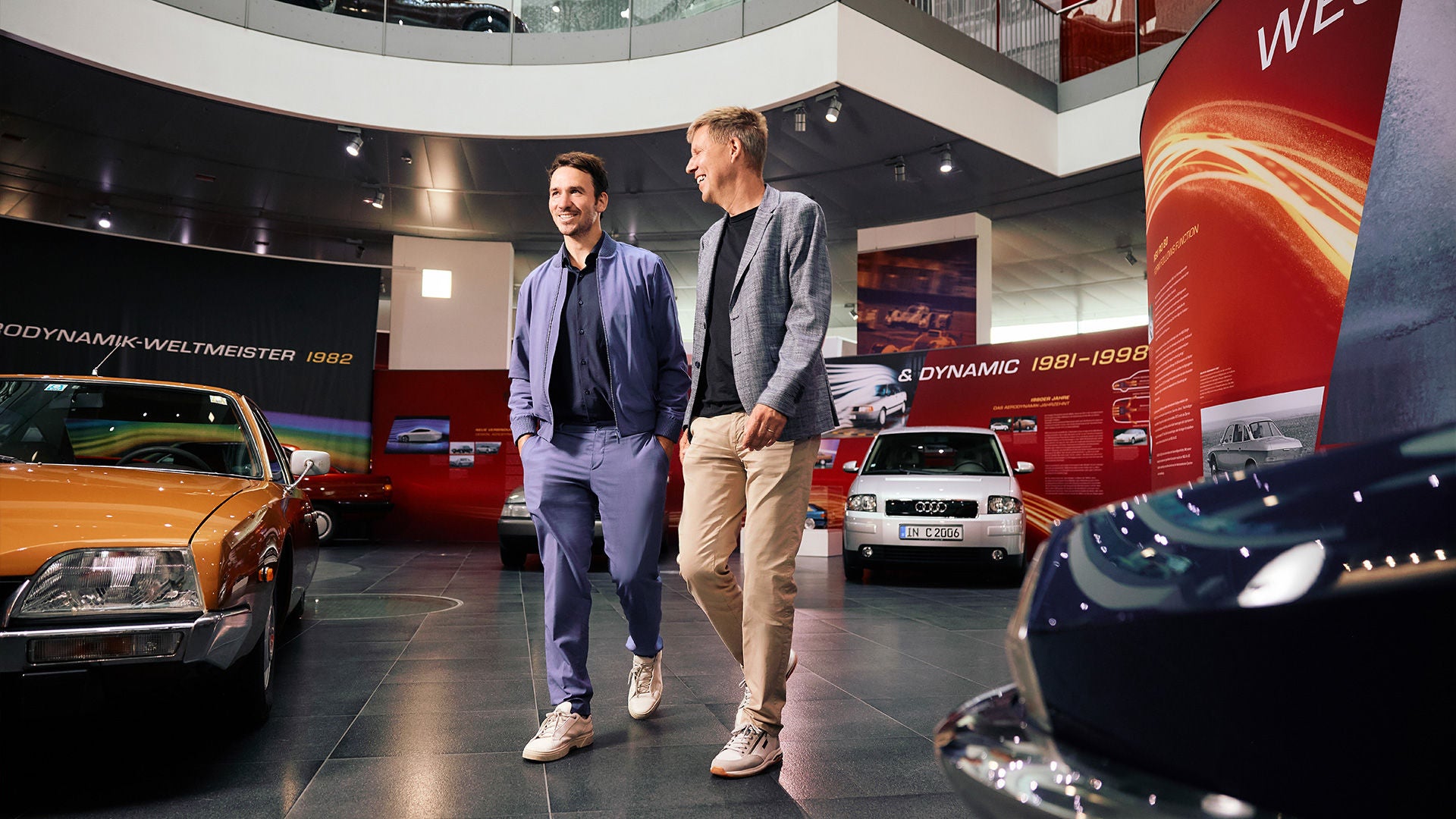
The ideal line to more sustainability
missing translation: fa.article-intro.reading-time – 11/12/2025

Audi RS e-tron GT: Power consumptiom (comibined) in kWh/100 km: 21,1–18,4 CO₂ emissions (kombiniert) in g/km: 0 CO₂ emission class: A
Audi RS e-tron GT: Power consumptiom (comibined) in kWh/100 km: 21,1–18,4 CO₂ emissions (kombiniert) in g/km: 0 CO₂ emission class: A
“You can feel it with every fiber of your being”
When former ski star Felix Neureuther leaves his house in Garmisch-Partenkirchen and walks past the stone-clad wall down to his underground garage and through the gray metal gate, he enters his very own electric domain. Next to an e-mountain bike and an electric lawn mower stands the latest treasure in his collection: the fully electric Audi RS e-tron GT. “This car is a beast. Its acceleration is incredible. You can feel it with every fiber of your being – it’s awesome!” says Neureuther enthusiastically.
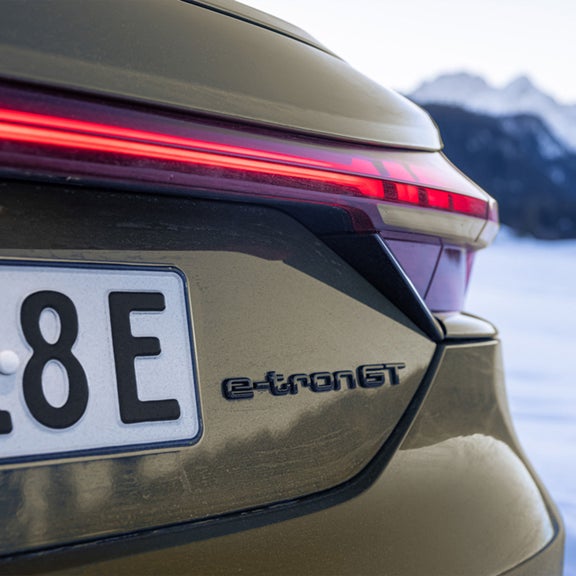
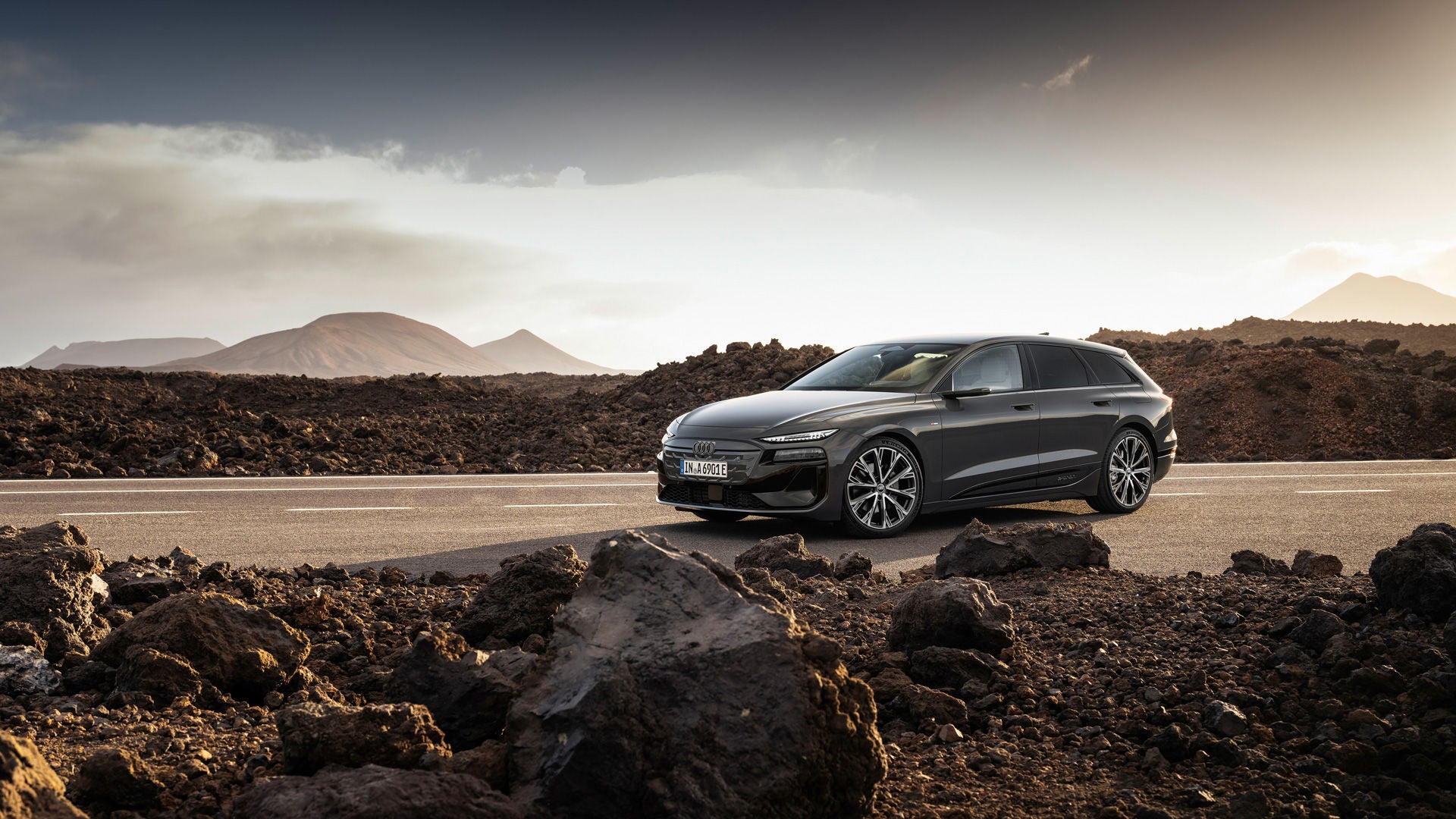
The Audi RS e-tron GT combines attractive design and technical innovation with pure power, delivering 475 kW (646 PS) in boost mode and acceleration from 0 to 100 km/h in 3.3 seconds in boost mode, while travelling locally carbon-neutral (combined electric power consumption in kWh/100 km: 20.2–19.3 (NEDC), 22.6–20.6 (WLTP); combined CO₂ emissions in g/km: 0).
Saving CO₂ emissions in procurement and production
To achieve this, Audi has a variety of measures in place in the upstream supply chain processes as well as in production and logistics.* The goal is ambitious: By 2050 at the latest, Audi aims to achieve net carbon neutrality* across its entire value chain. As of January 1, 2025, all Audi production sites* have been operating on a net carbon-neutral* basis. In 2018, the “CO₂ program in the supply chain” was also initiated with the aim of successively decarbonizing the supply chain. For this purpose, Audi Procurement relies on green energy, CO₂-reduced aluminum and CO₂-reduced steel as well as recycling concepts and secondary material in various areas. In this way, a total of approximately 350,000 metric tons of CO₂ equivalents* were avoided on a net basis throughout the supply chain in 2024.
There is a particular emphasis on aluminum, since its production is especially energy-intensive. The Four Rings have continually optimized recycling through the Aluminum Closed Loop.
In addition, parts are in use that are made from recyclates – that is, recycled materials – such as Econyl, which is made entirely from reprocessed nylon fibers and is used, among other things, as a material for carpets and floor mats for the Audi RS e-tron GT.

In accordance with its Code of Conduct the Four Rings work only with partner companies in the area of procurement that are committed to the same environmental protection values and goals in terms of environmental protection, employee rights and compliance (integral part of the contract). A Sustainability-Rating that is mandatory in the Volkswagen Group records and governs how suppliers are implementing sustainability standards.
Electric mobility supports climate protection
As an Audi brand ambassador and a parent, Felix Neureuther is also committed to sustainability. * For him, this is the issue facing us today and in the future. “As a father of two, I think we need to work to ensure that our planet remains livable for future generations,” says Neureuther. To achieve this, significant CO₂ reductions are required. Felix Neureuther understands the importance of electric mobility for climate protection: “It helps reduce CO₂ emissions. This is the only way we can leave a clean and healthy planet for future generations.”
The Bavarian is very attached to his homeland. He loves the mountains, the snow and the unspoiled landscape. His hope for the future is that his children will be able to enjoy it just as much as he can. His seven-year-old daughter Matilda also skis. And in 20 years’ time? The snow cover in Neureuther’s homeland is shrinking, and the effects of climate change have long since been noticeable in Upper Bavaria. “As a skier, I’ve experienced first-hand how the glaciers have changed over the years. It’s a frightening trend,” says Neureuther. To play his part, he has built a home designed for sustainability, featuring lots of wood, a state-of-the-art energy system in the basement and a photovoltaic system on the roof.
“The great thing about the photovoltaic system is that we can charge our electric car practically free of charge, which is just fantastic.” His delight is palpable. When Felix Neureuther pulls the cable out of his Audi RS e-tron GT in his garage after charging, he flashes a beaming smile that could even outshine the gleaming black and gray wall box.

“For a long time I’ve wanted a vehicle that combines sportiness and sustainability. The Audi RS e-tron GT is ideal for me – both logically and emotionally,” says Felix Neureuther. The Audi simultaneously radiates sportiness, high quality and comfort.
“For a long time I’ve wanted a vehicle that combines sportiness and sustainability. The Audi RS e-tron GT is ideal for me – both logically and emotionally,” says Felix Neureuther. The Audi simultaneously radiates sportiness, high quality and comfort.
Charging with green electricity
Audi is well aware that electric driving is only as “green” as the electricity used.* That is why the company is supporting customers in producing as little CO₂ as possible throughout the utilization phase of their electric models. Audi has a range of offers designed to make charging easy and, with renewable energy, environmentally friendly for as many customers as possible.
With Audi charging, the premium brand offers its customers a convenient charging solution that eliminates the need to compare different prices and tariffs.
Audi charging currently provides access to more than 600,000 public charging points in over 29 European countries, with further expansion planned.
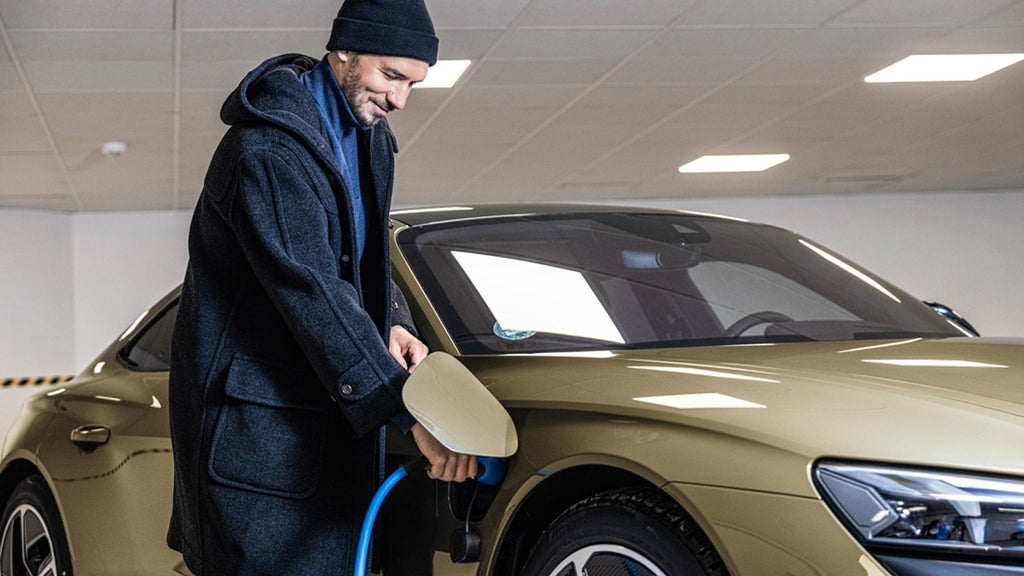
high-power-charging
For charging on the go, Audi is involved through the joint venture IONITY. The joint venture operates the largest pan-European high-power charging network, comprising over 4,500 charging points across 24 countries. Providing charging capacities above 250 kilowatts, the network is open to all electric vehicle brands. In addition, Audi offers its customers a service for charging at public stations through Audi charging. This service gives Audi drivers access to approximately 600,000 charging points across 29 European countries.

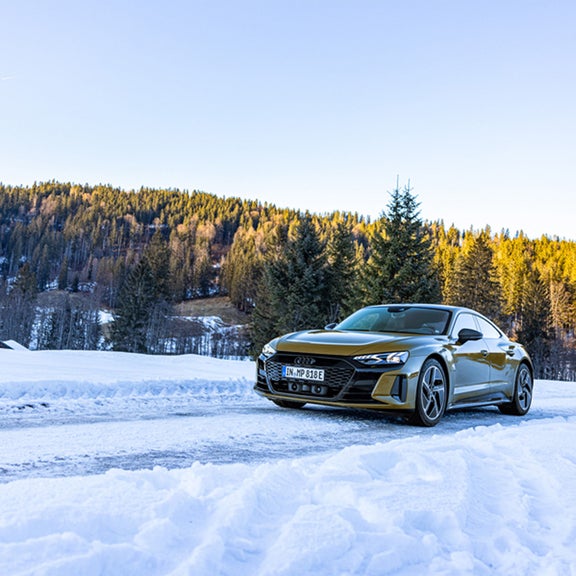
The Audi Audi RS e-tron GT takes a break. Felix Neureuther takes a moment to enjoy nature. As an Audi brand ambassador and father, he is committed to sustainability.
Audi RS e-tron GT: Power consumptiom (comibined) in kWh/100 km: 21,1–18,4 CO₂ emissions (kombiniert) in g/km: 0 CO₂ emission class: A
The Audi Audi RS e-tron GT takes a break. Felix Neureuther takes a moment to enjoy nature. As an Audi brand ambassador and father, he is committed to sustainability.
Audi RS e-tron GT: Power consumptiom (comibined) in kWh/100 km: 21,1–18,4 CO₂ emissions (kombiniert) in g/km: 0 CO₂ emission class: A
New life for old batteries
Even when the useful life of an electric Audi comes to an end, the company takes care of the recycling and other uses of the vehicle battery.*
Audi batteries are given a second life in applications such as fast-charging stations, for example at the Audi charging hub. Or they can be used as stationary energy storage devices to temporarily store electricity from power stations during phases of surplus energy. For this purpose, Audi is cooperating with the utility company RWE in the North Rhine-Westphalian town of Herdecke, for instance. RWE operates an energy storage system there that features used lithium-ion batteries from electric vehicles from Audi. With the help of 60 battery systems, this novel storage on the premises of the RWE pumped-storage power plant at the Lake Hengstey reservoir will provide intermediate storage of around 4.5 megawatt hours of electricity.
Seamless power
Felix Neureuther needs fast power, too, whether on the ski slopes or when driving his car in the Bavarian mountains. When he is behind the wheel, you can feel how much he loves sporty driving. He is particularly impressed with the stepless electric acceleration of the RS e-tron GT: “Torque is transmitted much more directly when accelerating compared with a combustion model. The power, the dynamics, everything is seamless. It’s hard to describe. You have to experience it for yourself.”
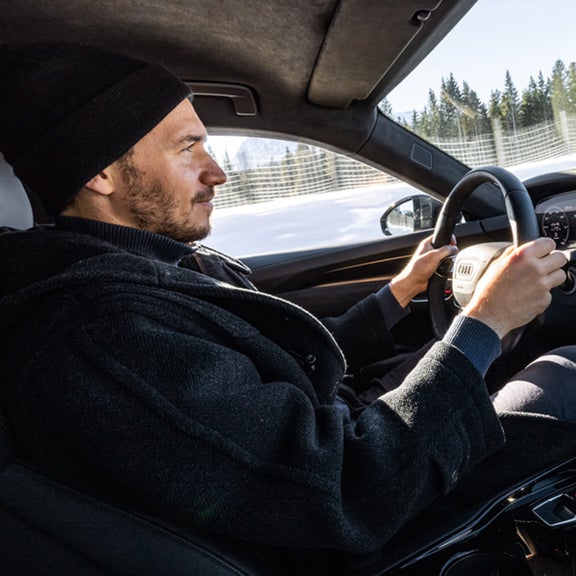
As the sun slowly sinks behind the snow-capped mountain peaks, Felix Neureuther takes a short break in the Audi RS e-tron GT to take in the magnificent panoramic views of the Alps. Nature was the Bavarian’s first great love, and he couldn’t imagine life without it: “For a long time I’ve wanted a vehicle that combines sportiness and sustainability. The Audi RS e-tron GT is ideal for me – both logically and emotionally.”
CO₂ targets and measures at Audi
More details
Audi has set itself ambitious targets. The company wants to play its part in upholding the Paris Climate Agreement by becoming net carbon-neutral* by 2050 at the latest. As of January 1, 2025, all Audi production sites* have been operating on a net carbon neutral basis. At the same time, Audi continues to systematically electrify its portfolio: by 2024, the brand already offered ten fully electric models. In the medium term, each core segmet will include at least one purely electric vehicle. In 2024 and 2025 alone, around 20 new models with different drive systems will celebrate their market launch, enabling Audi to remain both, robust and flexible during the transition from combustion engines to electric mobility.
On the road to climate-friendly mobility, Audi is using the decarbonization index (DCI)*, which is the central key indicator for climate targets for all brands in the Volkswagen Group. The DCI is a strategic indicator for reducing CO₂. The DCI factors in the entire value chain – from the extraction of raw materials and production to the provision of fuel and electricity and vehicle emissions to recycling. Audi is rigorously implementing measures at all points of the value chain.
Since 2021, the DCI has been an integral part of target achievement for the purposes of management remuneration. In 2022, the Environment, Social and Governance (ESG)-related components used to calculate management remuneration were expanded to include, for example, sales classified as “green” according to the EU taxonomy or the company’s performance in a sustainability rating.
Audi’s commitment to clean electricity
More details
Audi is actively driving regenerative power generation in Germany. The company is working with partners from the energy industry to build new wind and solar farms in Europe by 2025* These farms are expected to generate around five terawatt hours of additional green electricity, which corresponds to a capacity of around 250 new wind turbines, for example. The first project, a solar park in the German state of Mecklenburg-Western Pomerania, is being developed in collaboration with the German utility company RWE as a joint project with the Volkswagen Group. The plant came on stream in January 2022 and is designed for a total capacity of 170 million kilowatt hours. Encompassing nearly 420,000 solar panels, it is one of the largest independent solar parks in Germany, and further projects are in planning. Moreover, production of the Audi RS e-tron GT at the Böllinger Höfe facility in Neckarsulm uses 100 percent eco-electricity. The heat required for production is provided by a combined heat-and-power plant fired with biogas.
.jpg)