Search
All search results for "Daniel Kauer" (45)

Audi remains on track for transformation
Yvonne Bettkober for her outstanding leadership and the significant momentum she created during a defining phase for Audi. She played a vital role in making Audi more focused, efficient, and agile, while further developing a culture of responsibility and collaboration. Transformation is only possible as a team – and Team Audi will move forward and continue to shape this change together. We respect Yvonne’s decision and wish her all the best for the future.” In addition to his existing duties, Daniel Kauer, General Secretary and Head of Corporate Strategy, will assume responsibility for transformation on an interim basis. A decision regarding a permanent successor will be announced in due course.
Audi Report 2020
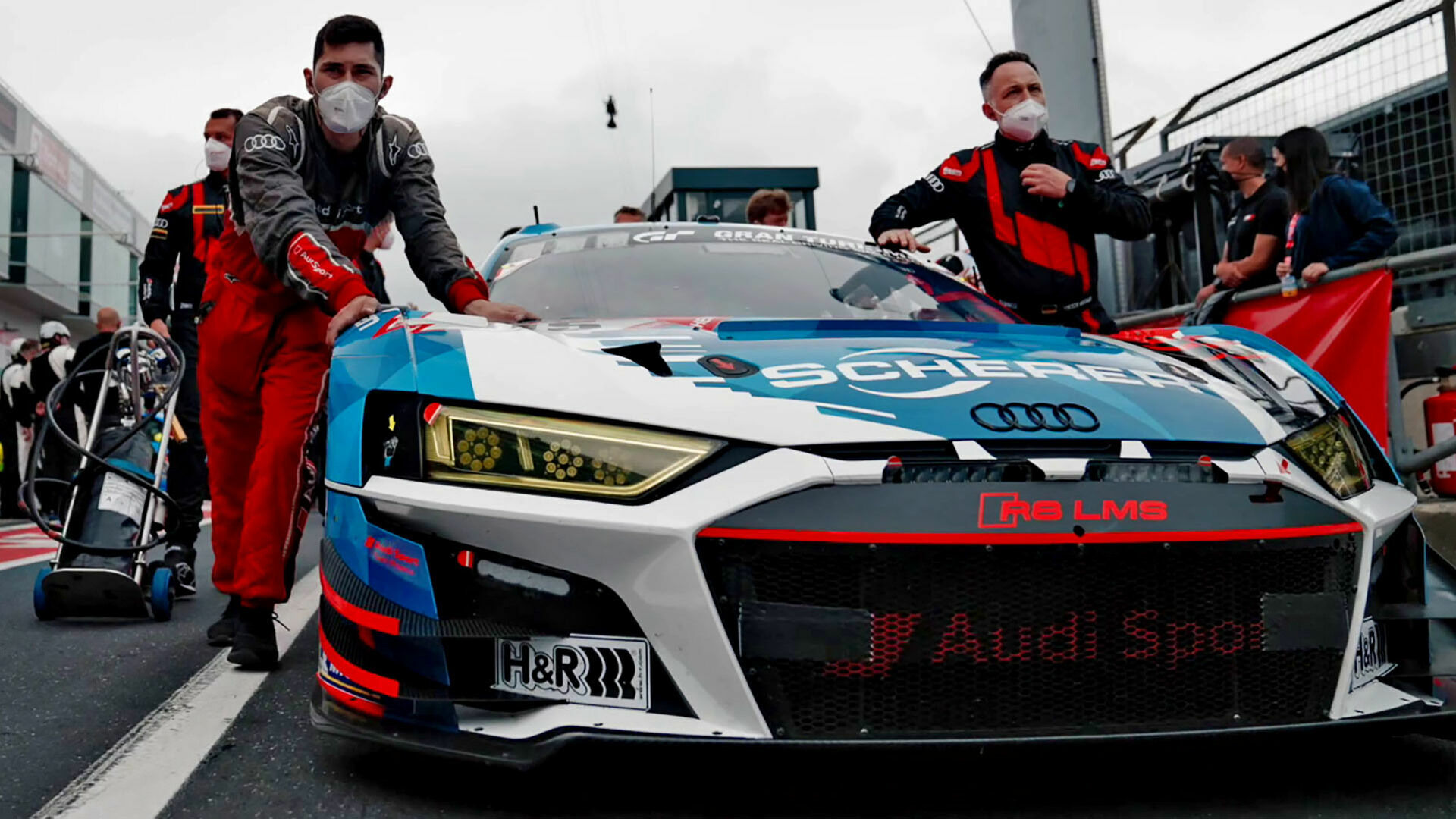
Health comes first. We responded very quickly and developed what is now a well- established framework for collaboration in the crisis team. That enabled us to make all the relevant decisions quickly and on a Group-wide basis. We deployed expert teams for every site and for each new coronavirus-related issue. These teams acted in close consultation with the departments and Works Council. Together we shut down production in March 2020 under controlled conditions and started it up again a short while later. That was a collective effort across the Audi production network globally, and I am especially proud of that. As a result, we managed to hit the ground running again with the usual quality standards and planned quantities. We quickly reached pre- coronavirus levels again in terms of production figures. As the coronavirus continues to persist, the task of supplying semiconductor components poses a serious challenge in the first quarter of 2021. However, our experienced crisis teams across the Group



Act4Impact Playbook
supply chains more sustainable. Simply click a topic to go directly to the relevant content. Global Battery Alliance Procurement with Purpose Supplier diversity & inclusion Aluminium Stewardship Initiative Human rights due diligence Implementation of human rights due diligenceRisk identification Policy commitment Tracking & communication Preventive measures Grievance management Regulatory requirements S-Rating Code of Conduct for Business Partners Energy and emissions Biodiversity Circular economy Water How can we recognize innovation? Decarbonization in the supply chain Methods of innovation Reduce Reuse Recycle 6 Thinking Hats SCAMPER Design Thinking 6-3-5 method Canvas People Environment Innovation 4 Regulatory requirements The regulations issued by legislative bodies in the context of responsible supply chains are becoming ever stricter as they strive to ensure sustainability and ethical business practices. You will find a selection of such regulatory requirements below. EU Deforestation

Audi Annual Report 2017
for mobility services in an urban environment by 2021. Audi is relying on a fast, agile structure to achieve this goal and has established its own software company especially for this purpose. www.aid-driving.eu 0 21 // 01//// AI IN THE GENES T E X T T E X T :: Li d ija M a ri n ko vi c Li d ija M a ri n ko vi c // P H O T O S : To b ia s S a g m ei st er Fuel consumption and emission fi gures at the end of the Annual Report0 2 2 ACTIVE NOISE CANCELLATION Psssst: With certain engines, the A8 is additionally equipped with Audi active noise cancellation. Selective counter-noise is emitted by the sound system speakers in order to suppress unwanted noise in the vehicle interior. This lets occupants concentrate on what is important. Or simply enjoy the silence. DYNAMIC ALL-WHEEL STEERING Sporty and safe: The optional function combines a sporty and direct steering response with maximum stability. At low speeds, the rear wheels are turned by up to fi ve degrees in the opposite direction to the front

Audi Annual Report 2018
be successful in making Audi the benchmark. We are Audi. « 2019 is an important year for Audi, a year of trans formation. The Audi Board of Management is driving the company’s new departure with these projects. Audi CEO Bram Schot has a plan for the Four Rings. B R A M S C H O T C h a ir m a n o f th e B o a rd o f M a n a g e m e n t o f A U D I A G a n d in te ri m M e m b e r o f th e B o a rd f o r M a rk e ti n g a n d S a le s P H O TO S: T h o m as D as h u b er , M at th ia s H as la u er , J en s P as so th Total expenditures of the company in the next five years around billion euros by 2023 4 5 » The future is already becoming reality in China. Many Chinese are enthusiastic about technological innovations. They view their smartphones as portable all-rounders for every area of their lives, including their cars, of course. In part, it is this openness and this hands-on mentality that make China, in my view, the orientation market for the mobility of the future – and they are also
Powering transformation from within
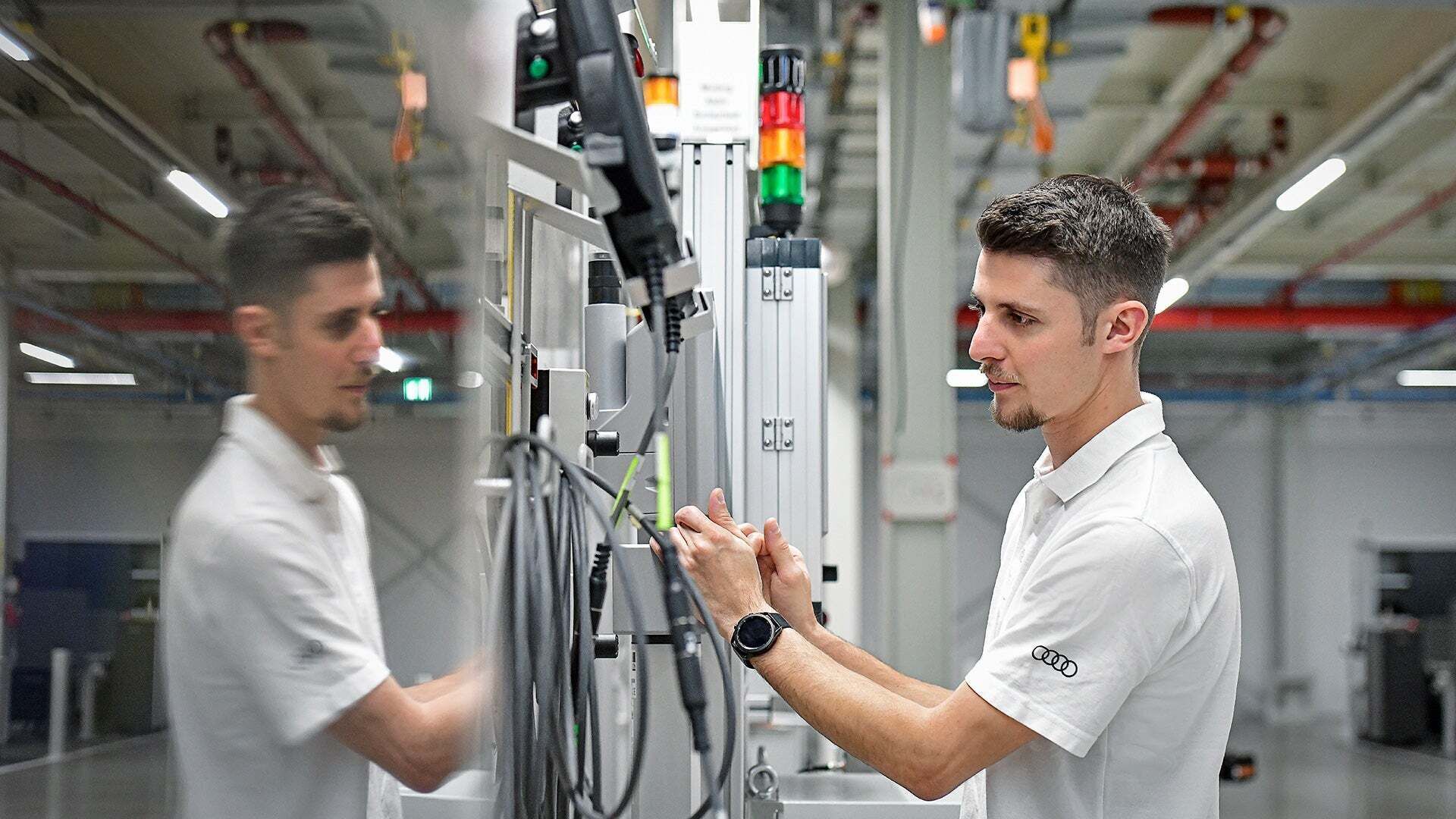
intensive training and development programs to prepare its workforce. A glance at the career progression of process optimizer Daniel Mayer and the establishment of the battery assembly facility in Ingolstadt shows how this works. In the Ingolstadt factory hall, myriads of orange-colored robot arms operate in six line sections to assemble the high-voltage batteries for Audi electric vehicles based on the Premium Platform Electric (PPE). “The assembly is highly complex technically, but actually quite easy to explain: There’s a tray including cooling system in which we mount the high-voltage battery system with its individual modules and connections onto a heat dissipation paste. We then glue down the lid and install a control unit as the interface to the vehicle. And before the battery is then finally ready, there are a number of safety tests to carry out,” explains Daniel Mayer.
Driving innovation through initiative The qualified electromechanical engineer began his career at Audi as a production


Data Protection Notice regarding Audi connect
government agencies in individual cases (e.g., when investigating a criminal offence). Government agencies are also authorised under applicable law to read data from vehicles themselves in individual cases. In the event of an accident, for example, information can be read from the airbag control unit that can help to investigate it. 2. Operating Data of the Vehicle Control units process data to operate the vehicle. This includes for example: Vehicle status information (e.g., speed, deceleration, lateral acceleration, wheel revolution speed, whether the seat belts are fastened), Environmental conditions (e.g., temperature, rain sensor, distance sensor). This data is generally volatile – it is not stored after the vehicle is switched off and is only processed in the vehicle itself. Control units often contain data memory (sometimes also including the vehicle keys). These are used to temporarily or permanently document information about vehicle status, component stress, maintenance requirements

Company history
The eventful history of Audi began in the 19th century, with the first chapter written by August Horch, one of the German pioneers of automotive engineering. After graduating from the Technical Academy in Mittweida, Saxony, he initially worked in engine construction and later as operations manager in motor vehicle production at the Carl Benz company in Mannheim. On 14 November 1899, with the establishment of the company A. Horch & Cie. in Cologne, he laid the foundation for what would become a world-famous brand.
A second chance – from Horch to Audi
In 1902, Horch relocated his company to Reichenbach in Saxony. And in 1904, he registered it as a joint-stock company and moved to Zwickau. However, just five years later, he left the company due to differences of opinion and founded a new car company. Because he was not allowed to use his own name again, it was translated into Latin. The idea of using the imperative form of the Latin word for “to hear” – that is, “Audi!” which in German