Search
All search results for "s4 tdi" (62)

Audi S4 Avant TDI (until 202)
Audi S4 Avant TDI (until 2023)
For the first time ever, the Audi S4 Avant has a V6 diesel under the hood. The 3.0 TDI engine produces 255 kW (347 hp) and delivers up to 700 Nm (516.3 lb-ft) of torque to the crankshaft. An electric powered compressor provides for strong off-the-line performance; a mild hybrid system enhances efficiency. This combination of power, torque and efficiency makes the S4 unique in its segment.
Pictures Audi S4 Avant (until 2023)
Video Audi S4 Avant (until 2023)
Engine type V6 engine
Displacement in cc / bore x stroke in mm / compression 2967 / 83.0 x 91.4 / 15.5
Max. power output in kW (hp) / at rpm 251 (341) / 3800 - 3950
Max. torque in Nm (lb-ft) / at rpm 700 (516.3) / 1750 - 3250
Top speed in km/h (mph) 250 (155.3) (governed)

Audi S4 Sedan TDI (until 2023)
Audi S4 Sedan TDI (until 2023)
For the first time ever, the Audi S4 Sedan has a V6 diesel under the hood. The 3.0 TDI engine produces 255 kW (347 hp) and delivers up to 700 Nm (516.3 lb-ft) of torque to the crankshaft. An electric powered compressor provides for strong off-the-line performance; a mild hybrid system enhances efficiency. This combination of power, torque and efficiency makes the S4 unique in its segment.
Pictures Audi S4 Sedan (until 2023)
Videos Audi S4 Sedan (until 2023)
Engine type V6 engine
Displacement in cc / bore x stroke in mm / compression 2967 / 83.0 x 91.4 / 15.5
Max. power output in kW (hp) / at rpm 251 (341) / 3800 - 3950
Max. torque in Nm (lb-ft) / at rpm 700 (516.3) / 1750 - 3250
Top speed in km/h (mph) 250 (155.3) (governed)


The Audi S4 TDI
Audi is committed to TDI technology: For the first time, both S models in the A4 family are using a V6 diesel engine – the Audi S4 Sedan TDI (combined fuel consumption in l/100 km: 6.3–6.2* (37.3–37.9 US mpg); Combined CO2 emissions in g/km: 164–163* (263.9–262.3 g/mi)) and the S4 Avant TDI (combined fuel consumption in l/100 km: 6.3* (37.3 US mpg); combined CO2 emissions in g/km: 166–165* (267.2–265.5 g/mi)). The 3.0 TDI produces 255 kW (347 metric hp) of power and up to 700 Nm (516.3 lb-ft) of torque. A mild hybrid system based on a new 48-volt main on-board electrical system increases efficiency, while the electric powered compressor (EPC) ensures powerful drive-off performance. This combination of power, torque, efficiency and spontaneity is unique in the segment. The 3.0 TDI: brawny torque The 3.0 TDI, the most powerful configuration level in Audi’s V6 diesel series, combines brawny performance with high efficiency. Its output is 255 kW (347 metric hp), and 700 Nm (516.3 lb-ft) of
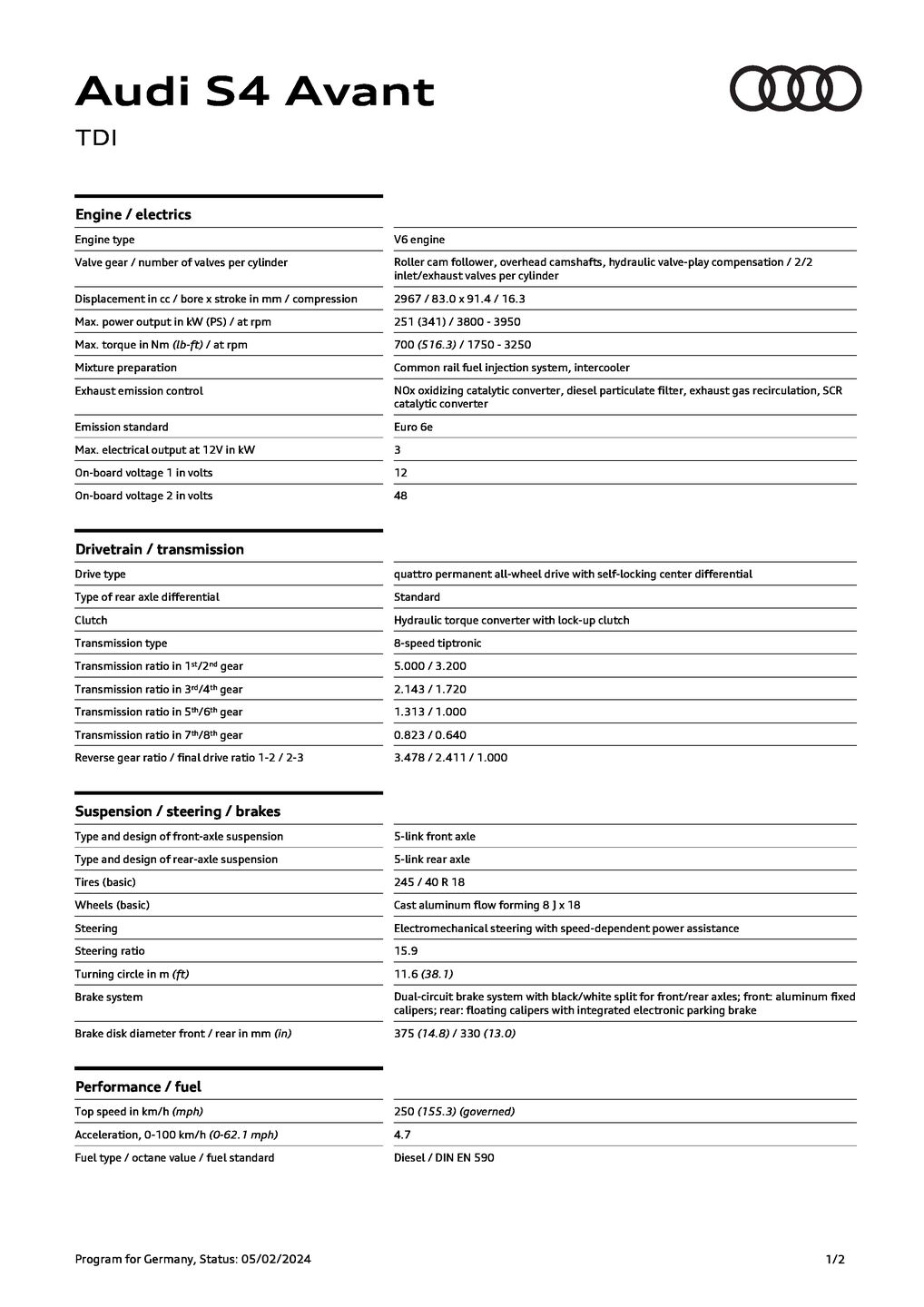
S4 Avant TDI (until 2023) (251 kW)
Program for Germany, Status: 05/02/2024 1/2 Audi S4 Avant TDI Engine / electrics Engine type V6 engine Valve gear / number of valves per cylinder Roller cam follower, overhead camshafts, hydraulic valve-play compensation / 2/2 inlet/exhaust valves per cylinder Displacement in cc / bore x stroke in mm / compression 2967 / 83.0 x 91.4 / 16.3 Max. power output in kW (PS) / at rpm 251 (341) / 3800 - 3950 Max. torque in Nm (lb-ft) / at rpm 700 (516.3) / 1750 - 3250 Mixture preparation Common rail fuel injection system, intercooler Exhaust emission control NOx oxidizing catalytic converter, diesel particulate filter, exhaust gas recirculation, SCR catalytic converter Emission standard Euro 6e Max. electrical output at 12V in kW 3 On-board voltage 1 in volts 12 On-board voltage 2 in volts 48 Drivetrain / transmission Drive type quattro permanent all-wheel drive with self-locking center differential Type of rear axle differential Standard Clutch Hydraulic torque converter with lock-up clutch Transmission
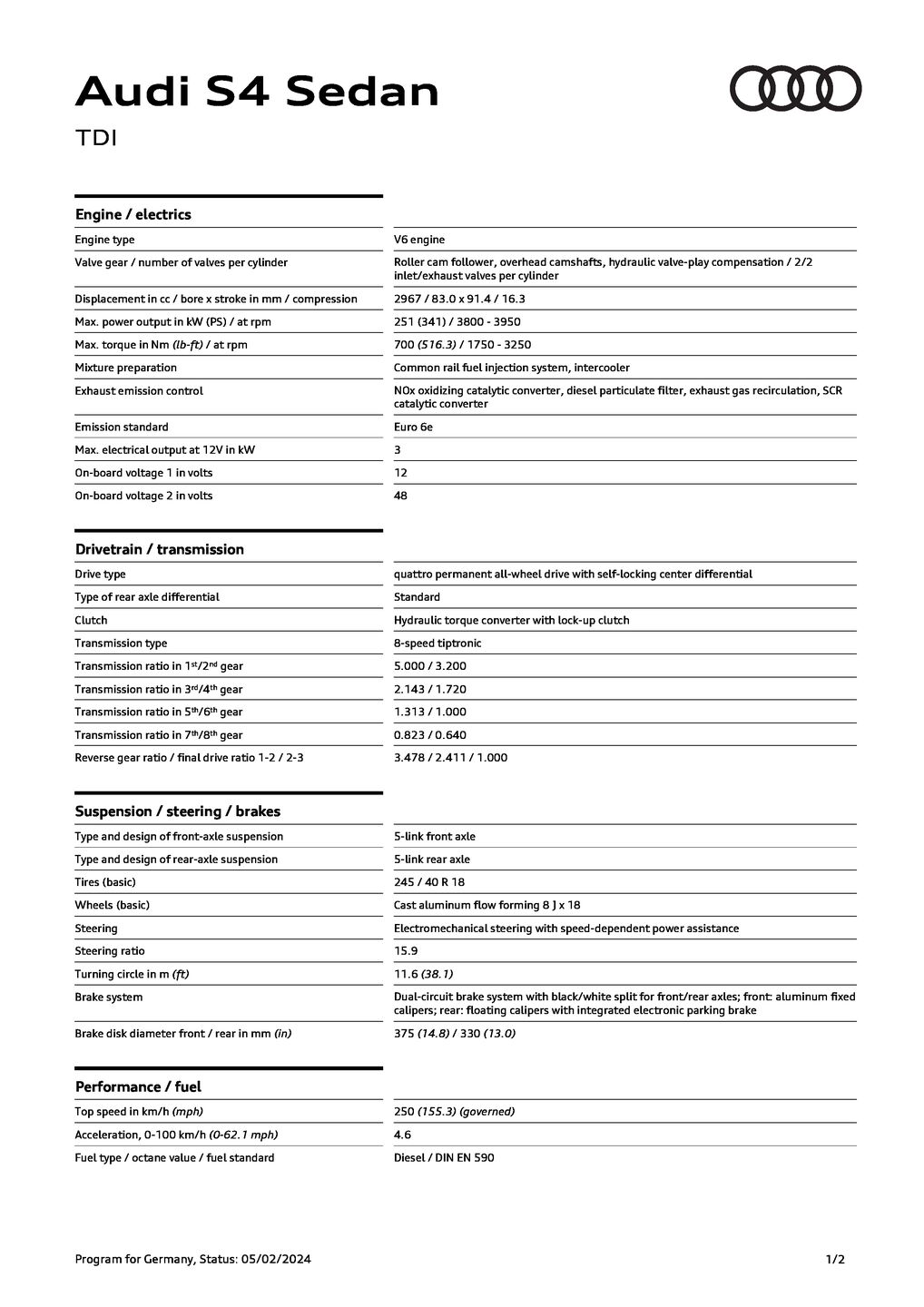
S4 Sedan TDI (until 2023) (251 kW)
Program for Germany, Status: 05/02/2024 1/2 Audi S4 Sedan TDI Engine / electrics Engine type V6 engine Valve gear / number of valves per cylinder Roller cam follower, overhead camshafts, hydraulic valve-play compensation / 2/2 inlet/exhaust valves per cylinder Displacement in cc / bore x stroke in mm / compression 2967 / 83.0 x 91.4 / 16.3 Max. power output in kW (PS) / at rpm 251 (341) / 3800 - 3950 Max. torque in Nm (lb-ft) / at rpm 700 (516.3) / 1750 - 3250 Mixture preparation Common rail fuel injection system, intercooler Exhaust emission control NOx oxidizing catalytic converter, diesel particulate filter, exhaust gas recirculation, SCR catalytic converter Emission standard Euro 6e Max. electrical output at 12V in kW 3 On-board voltage 1 in volts 12 On-board voltage 2 in volts 48 Drivetrain / transmission Drive type quattro permanent all-wheel drive with self-locking center differential Type of rear axle differential Standard Clutch Hydraulic torque converter with lock-up clutch Transmission
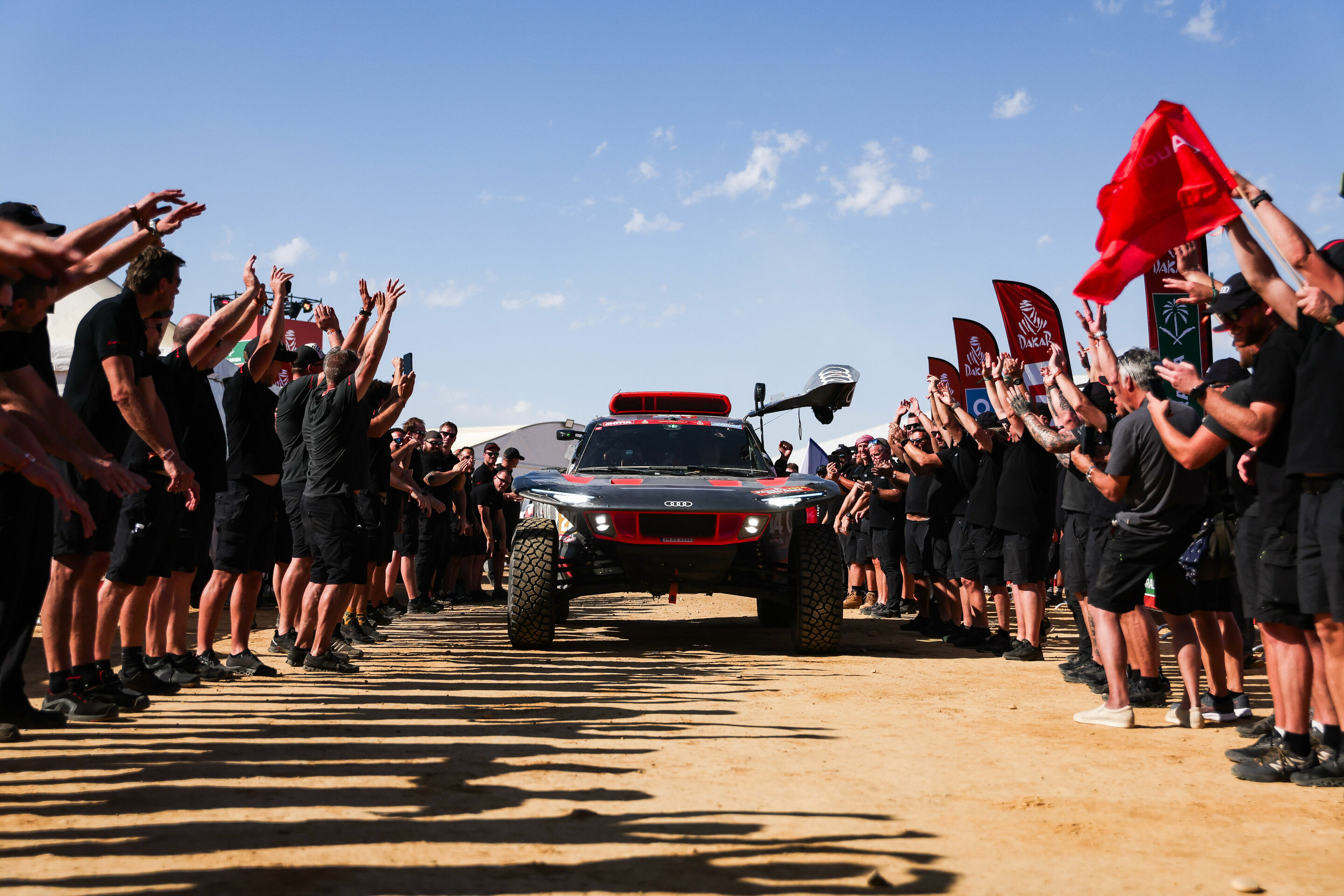
Audi’s most important motorsport successes
Drivers and Manufacturers classification FIA World Endurance Championship (Audi R18 e-tron quattro) Winner Sebring 12 Hours (Audi R18 TDI) Winner Bathurst 12 Hours (Audi R8 LMS) Winner Nürburgring 24 Hours (Audi R8 LMS ultra) Winner Spa 24 Hours (Audi R8 LMS ultra) Winner Blancpain Endurance Series (Audi R8 LMS ultra) Winner Teams classification Blancpain Endurance Series (Audi R8 LMS ultra) Winner Gentlemen Trophy Blancpain Endurance Series (Audi R8 LMS) Winner Teams classification Gentlemen Trophy Blancpain Endurance Series (Audi R8 LMS) Winner Portuguese GT Championship (Audi R8 LMS ultra) Winner Taça Portugal (Audi R8 LMS ultra) Winner Iberian Supercars Trophy (Audi R8 LMS ultra) Winner Spanish GT3 Championship (Audi R8 LMS ultra) Winner GT Cup Macau (Audi R8 LMS ultra) 2011 Winner Drivers classification DTM (Audi A4 DTM) Winner Le Mans 24 Hours (Audi R18 TDI) Winner Spa 24 Hours (Audi R8 LMS) Winner Bathurst 12 Hours (Audi R8 LMS) Winner Italian GT3 Championship (Audi R8 LMS) Winner Spanish


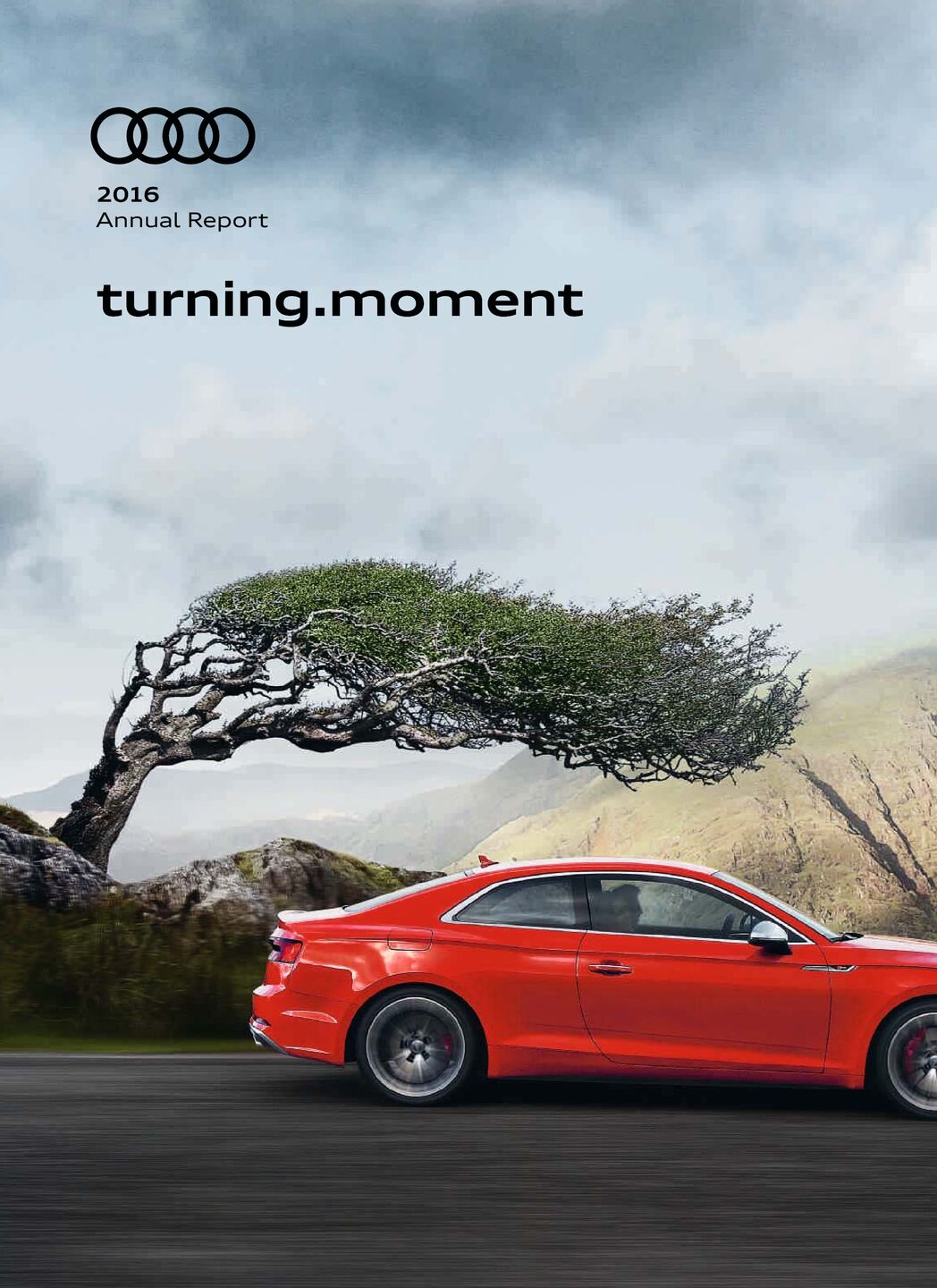
Audi Annual Report 2016
min. emission-free mobility Audi combustion engines are steadily becoming more efficient. The Four Rings are turning primarily to mild hybrids that support the combustion engine electrically and can use recuperation, for example, to reduce fuel consumption. Within the next ten years, Audi is planning to offer this technology in all models with a conventional drive system. The higher-power 48-volt electrical system, which made its series-production debut as an electrical subsystem in the Audi SQ7 TDI, enables a multitude of innovative and attractive technologies for the drive system and suspension, such as the electric powered compressor. This supports the two turbochargers, especially at lower engine speeds, to provide for very dynamic off-the-line performance. To also reduce the CO2 emissions of its combustion engines, Audi is developing synthetic and therefore petroleum-independent fuels such as Audi e-benzin® or Audi e-diesel®. Fuel production follows the Audi e-fuels formula: The amount
Audi Annual Report 2017
concerning the V6 3.0 TDI engine, as well as human resources decisions accounted for a significant portion of the Supervisory Board’s work in the reporting year. The Supervisory Board was kept constantly informed of the diesel crisis by the Board of Management in the past fiscal year, both in writing and orally. This applies in particular to events in the United States, but also in other countries or regions of the world, for example South Korea, Japan, Australia and Europe. In this connection the Supervisory Board held four extraordinary meetings in the past fiscal year. In addition to its four ordinary meetings, the Presiding Committee of the Supervisory Board held four extraordinary meetings in 2017. The purpose of the extraordinary meetings of both bodies was, for example, to prepare and pass resolutions on the “DoJ Criminal Settlement Agreement,” the “2nd” and “3rd Partial Consent Decree,” the “CBP Settlement Agreement” as well as the situation regarding the V6 and V8 TDI engine in Europe