From concept to reality: How Audi is shaping the next generation of agile software development

Alexander Lang works as a Project Lead at Audi, where he is responsible for the end-to-end orchestration of the first generation of the SDV architecture. In collaboration with international partners, he shapes agile development processes and integrates complex electronic control units into a future-ready platform. In the interview, he discusses the challenges of this transformation, new modes of collaboration and the critical role of trust, team spirit, and courage in large-scale transformation projects.
How did you come to Audi?
Alexander: I’ve been fascinated by Audi ever since I was a child. My father was a passionate Audi driver, and even back then I was particularly drawn to the brand’s design and technology. On top of that, my very first car was an Audi as well – a burgundy first generation Audi A3. Since then, I’ve felt a strong connection to the four rings.
It was clear to me early on: after my studies, I really wanted to work at Audi. I started my career through my diploma thesis on production method simulation, which gave me the opportunity to join the company. There, I experienced first hand how deeply technology and design are intertwined at Audi – and how unique and approachable the company culture is.
Today, I am the Project Lead at Audi, overseeing the SDV 0.1 architecture end to end, with a strong focus on engineering excellence, on time delivery, cost control, and quality assurance.
“We are shaping the software architecture of tomorrow – agile, interconnected and committed to reliably integrating complex systems.”
What are you currently working on?
Alexander: I am currently working together with Rivian & Volkswagen Group Technologies (RV Tech) on the software architecture of our first fully realized SDV model.
As part of an integrated, cross-functional team, we are driving the agile implementation of the software. Our focus is on both industrializing the architecture and gradually ramping up functionality for upcoming vehicle programs—always with the goal of consistently embedding Audi’s DNA into the software.
Another key aspect of my role is group wide alignment across the SDV landscape. The objective is to synchronize architectural decisions, development processes, and interfaces in a way that enables a scalable, update capable, and future proof software platform.
What exactly does that mean?
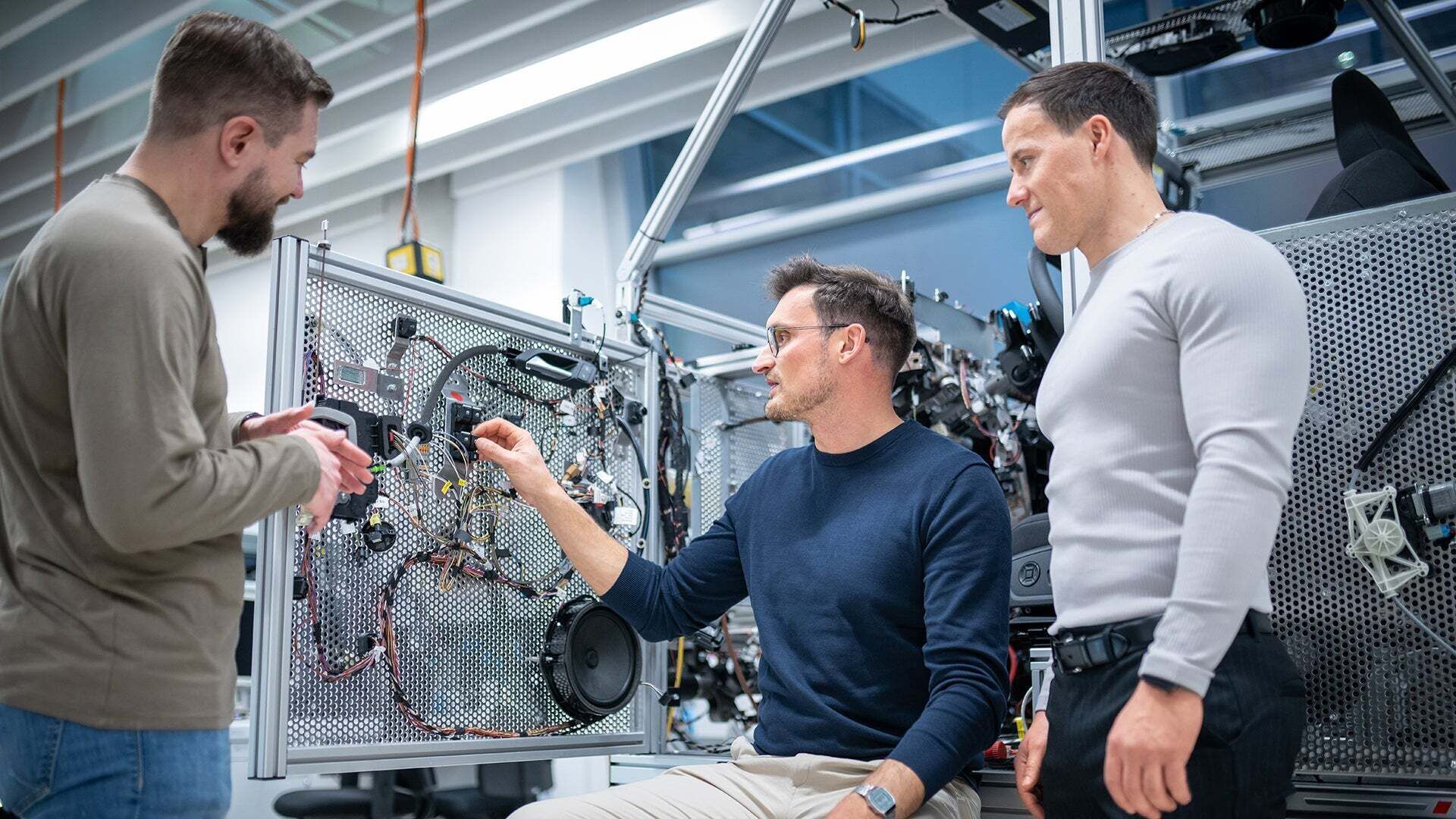
Alexander: Software has become the vehicle’s central nervous system. Our mission is to build an architecture that is flexible, scalable, and future ready. Right now, the focus is on integrating RV Tech’s zone control units and our Audi control units into the new architecture. My job is to bring these components together with their hardware and software – technically and organizationally.
This is challenging because the architecture only works as a whole if all control units can communicate seamlessly. To enable this, we work directly on the base software early in the project, ensuring that all control units speak the same language.
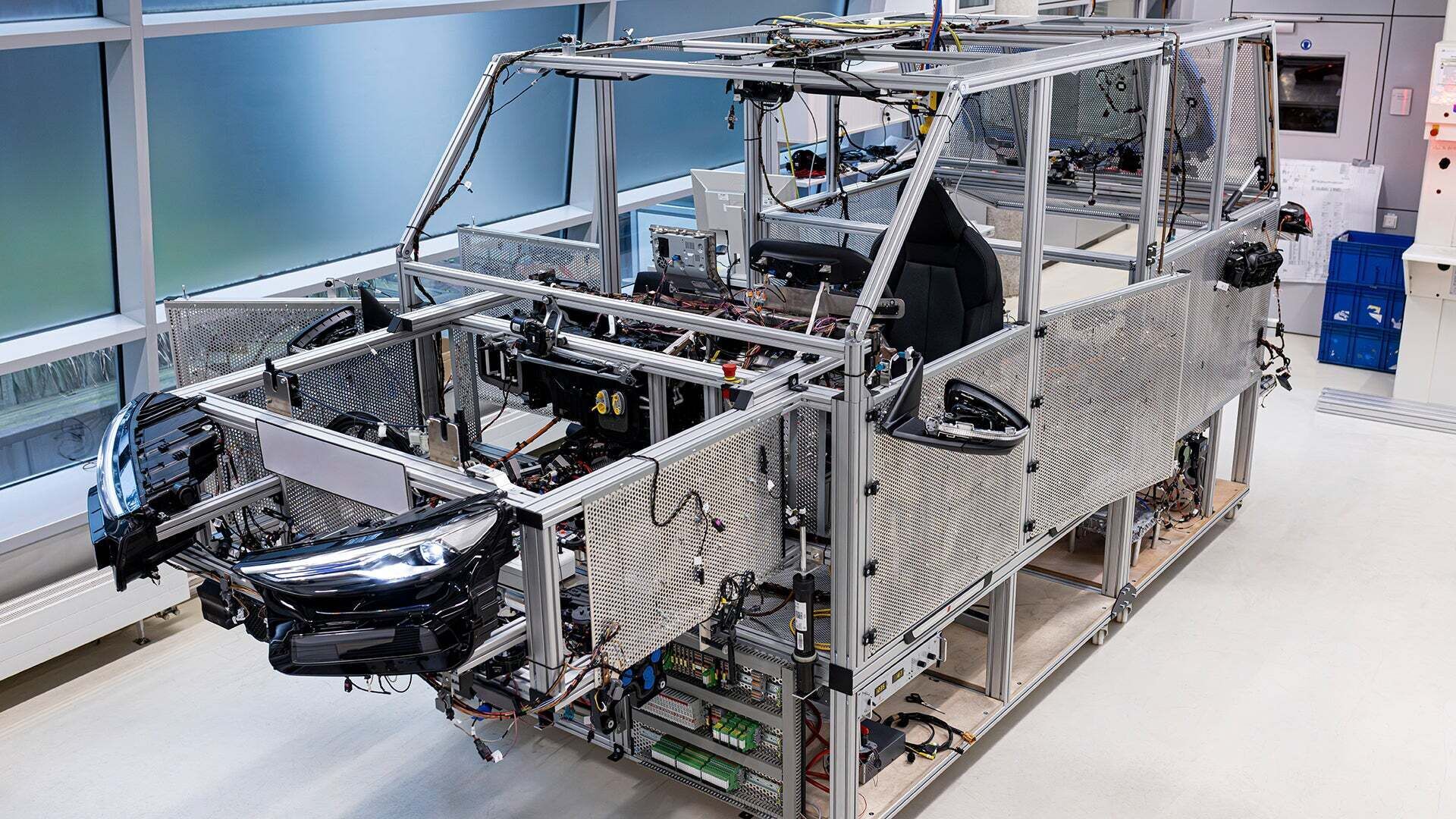
One key milestone was the SDV Lab – a test environment without a vehicle body, equipped with control units, wiring, and mainframes. In this setup, we develop and validate the architecture in a realistic environment long before it’s integrated into a vehicle. We see the SDV Lab as a central hub for our development teams, where everyone comes together to build the software of tomorrow.
“Software is now the central nervous system of the vehicle. Our task: to create an architecture that is flexible, scalable and future-proof.”
Alexander Lang, Project Lead Electrical / Electronic SDV0.1 at Audi
Do you work with innovative methods? Where do you use AI, for example?
Alexander: Absolutely. We follow SDV specific development principles and rely on modern software architectures and development methodologies.
Artificial intelligence plays a key role, especially when it comes to handling and analyzing large volumes of data. Manually sorting and evaluating this data for specific use cases simply wouldn’t be efficient.
AI significantly accelerates our work and enables us to execute complex integration tasks far more efficiently and accurately.
Thanks to your collaboration with Rivian & Volkswagen Group Technologies, you are also more often in the United States. What is your experience of the collaboration?
Alexander: I really enjoy the collaboration because the way of working there fits perfectly with my own approach. I prefer hands on problem solving over spending hours discussing the perfect plan.
In the US, the mindset is different: instead of planning three years ahead, teams work in clear quarterly cycles. They set concrete goals for the next three to four months and execute them in an agile way – with tremendous energy and a strong focus on results.
This pragmatic approach really inspires me. Every visit is enriching: I don’t just bring back technical input, but also the energy and team spirit you can genuinely feel there.
What do you take away from this for your own collaboration?
Alexander: We’re adapting to these new ways of working step by step – starting with basics like adjusting working hours to manage a nine hour time difference. At the same time, we want to keep up with the high pace of software development and actively help shape it.
In software development, we already work very differently today: requirements, implementation, and testing happen in fast cycles – sometimes within just 24 hours. It’s a completely different pace, and we’re learning to adopt that mindset.
Our goal isn’t to copy speed one to one, but to introduce agile methods together with our partners and adapt our processes so we can react faster and enable regular software updates.
One of the most critical success factors is the team. We truly work as one—and that’s what makes the real difference. Without a strong, trust based team, it’s simply not possible to sustain both speed and quality over time. Everyone brings their unique strengths to the table, and we actively support each other. This shared mindset builds reliability, drives motivation, and ultimately delivers the results we’re seeing today.
It’s an exciting transformation that makes us significantly more agile while still ensuring high quality – and that’s exactly what motivates me about this role.
What drives you in your job? Where do you draw your motivation from?
Alexander: I’m motivated primarily by technical innovation and the opportunity to actively shape it. That ranges from developing new technologies to transforming the way we work. This breadth of responsibility offers an incredible amount of creative freedom – and that’s exactly what I love about the job.
What excites me most is taking others along on this journey. At first, there’s often some hesitation – which is completely normal. But once people understand why we’re doing things differently, there’s a moment when teams start working independently on complex technical topics using new methods.
Those small wins are what really energize me, even though the process often pushes us outside our comfort zone.
„I am motivated by technical innovations – and the opportunity to actively participate.“
Alexander Lang, Project Lead Electrical / Electronic SDV0.1 at Audi
Is there a special Audi tech moment that you can describe?
Alexander: There are quite a few, but what really stands out to me is what we’ve achieved recently together with Rivian and Volkswagen Group Technologies.
During development, we sometimes fix software issues within minutes, working side by side with experts. No lengthy communication chains – just direct collaboration with the software specialists. This clearly shows what agile methods and short paths can achieve.
For me, moments like these are a clear sign that we’re on the right track.
How are the Audi values – trust, responsibility, courage and enthusiasm – reflected in your daily work?
Alexander: Change is always challenging – especially when new technologies and ways of working come into play. In our case, that means having the courage to question established structures.
A great example is the first SDV Lab for the new architecture: a completely new test environment that we set up together in a very short time, allowing us to stabilize the architecture and software at a very early stage.
This was only possible because everyone involved was willing to take ownership and place trust in the team and the new approach. At the beginning, there was hesitation and a lot of open questions, but through transparency and close collaboration, we were able to demonstrate the benefits and bring everyone on board.
Today, the SDV Lab is a central building block of our software development. We already deploy software to the test environment over the air at this early development stage. To me, this clearly shows that with courage, trust, and enthusiasm, we can successfully drive major change.