
The materiality analysis of AUDI AG
What impact does Audi make on the environment and society? Which environmental and social issues influence the company? And how do stakeholders assess this? The Audi materiality analysis provides the answers.
As a global company, AUDI AG operates in a complex environment – a continuous review of its own ESG and corporate goals is essential for success. It is important to the company to always keep an eye on the opportunities and risks of its actions in order to systematically evaluate the identified effects of business activities on environmental and social issues and to incorporate them into internal decision-making processes.
Since 2024, the Corporate Sustainability Reporting Directive (CSRD) has governed the sustainability reporting requirements for companies in the EU. These now have to provide detailed non-financial information on environmental, social and governance issues in their management reports. The CSRD provides the regulatory framework for this reporting. The content to be reported and the report structure are defined by the European Sustainability Reporting Standards (ESRS). As with financial reporting, sustainability reports should focus on meaningful information and topics that are relevant and assessable for stakeholders. This limitation is referred to as materiality.
Audi voluntarily publishes a report that combines financial and ESG aspects. The Audi Report is based on the European CSRD, specifically incorporating the key figures this requires, and addresses the material topics in accordance with the CSRD.
Double materiality analysis for more transparency
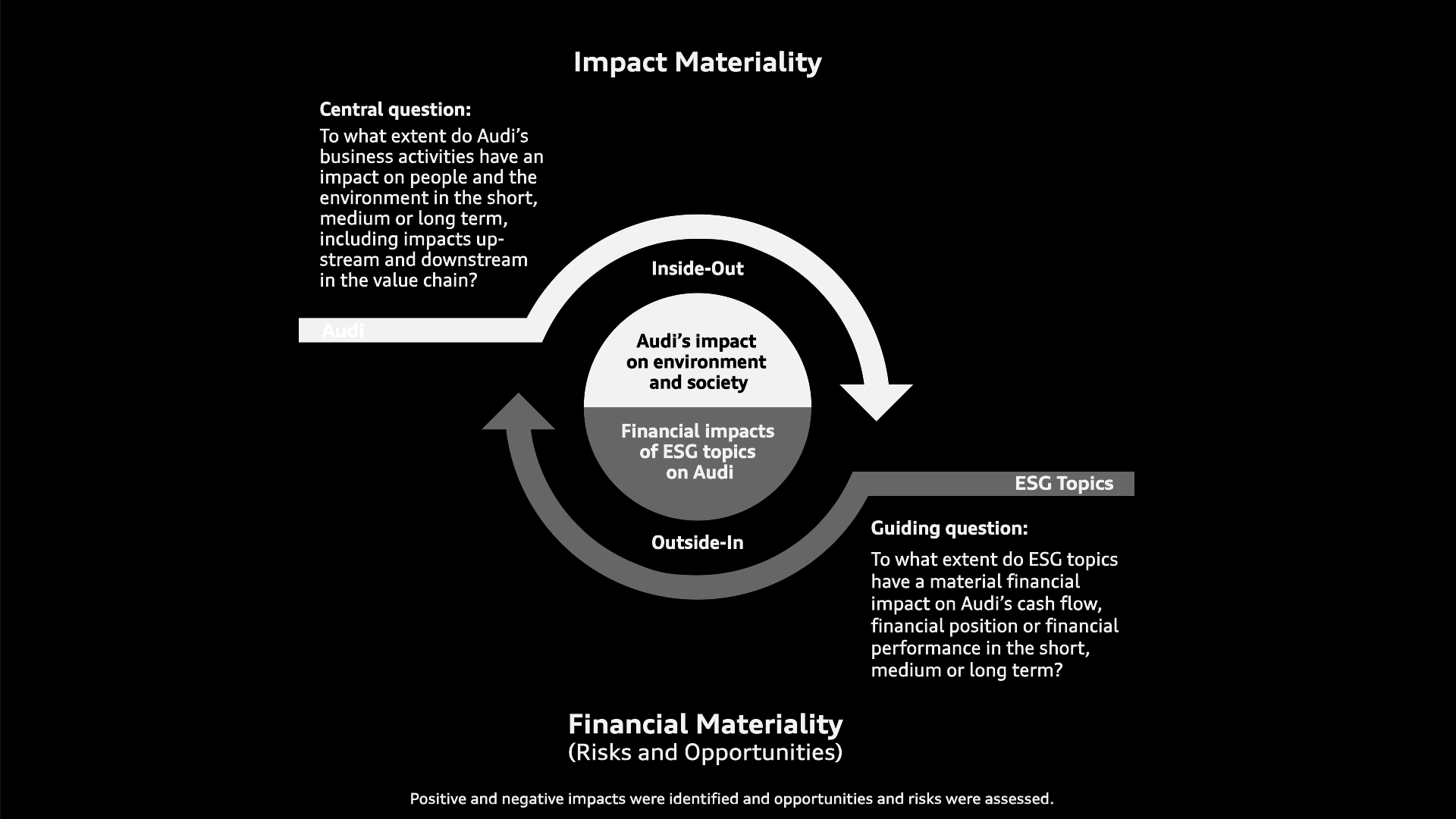
The materiality analysis that Audi has been conducting for 12 years serves to determine these topics, since it creates transparency on relevant ESG topics in the context of sustainability. In 2024, Audi introduced the concept of “double materiality,” as required by the CSRD. This principle requires companies to consider the materiality of sustainability topics from two perspectives. The inside-out perspective (impact materiality) is used to determine the actual and potential positive and negative impacts of the company’s activities on various sustainability topics. The outside-in perspective (financial materiality) is used to determine the opportunities and risks that sustainability topics pose for the company’s financial performance.
Audi uses the double materiality analysis as a strategic tool. It makes a contribution to the regular review of objectives and the use of resources and therefore to the further development of the company. It helps to systematically analyze the interrelationships between economic development and identified ESG risks and opportunities. The idea is as follows: If the company is aware of its impacts and can manage accordingly, it can act optimally both with regard to risk minimization and opportunity maximization as well as resource allocation.
Update of the materiality analysis
In the year under review, Audi partially adjusted the materiality analysis conducted in 2024. The specifications of the Volkswagen Group as well as the ESRS served as content guidelines for the analysis. The ESRS are divided into 37 subtopics, which form the basis for the company’s materiality analysis. During 2024, the company also carried out a comparison with the topics considered relevant by competitors, in the Volkswagen Group and in external ESG frameworks and ESG ratings. Two additional topics, which go beyond the ESRS, were derived from this: The topic of “sustainable business development” was classified as material in the course of expert interviews and “social commitment” was also included as a material topic for AUDI AG in alignment with the Volkswagen Group’s materiality analysis. In total, the company consequently subjected 39 topics to a more detailed assessment.
In a further step, AUDI AG conducted stakeholder interviews in 2024. The evaluation of these interviews identified for each topic potential positive and negative impacts of Audi business activities on the environment and society (impact materiality) and, in addition, opportunities and risks for the company (financial materiality). Based on impact materiality and financial materiality, the 39 topics were classified as material or not material for the company. Internal experts reviewed these results again in 2025 and then made slight adjustments to the topics.
In the year under review, Audi confirmed the topics already classified as material in 2024 – with the exception of “impacts on biodiversity” and “impacts on the extend and condition of ecosystems.” These topics were classified as “not material” based on the risk assessment by internal experts and in alignment with the Volkswagen Group’s materiality analysis. In addition, the new topics “soil pollution” and “economic, social and cultural rights of communities” were classified as material for AUDI AG. The company then aligned the assessment of the topics with the Volkswagen Group.
Overview of the key topics
E – Environment & Resources
| Key topics | Key subtopics | Reporting by Audi |
| Climate change |
| Climate change and energy efficiency |
| Environmental pollution |
| Reduction in environmental pollution |
| Water and marine resources |
| Water management |
| Biodiversity and ecosystems |
| Biodiversity |
| Circular economy |
| Resource management and circular economy |
S – People & Society
| Key topics | Key subtopics | Reporting by Audi |
| Company workforce |
| Fair working conditions and modern working forms |
| Workers in the value chain |
| Responsibility in the supply chain |
| Affected communities |
| |
| Consumer and end users |
|
G – Governance
| Key topics | Key subtopics | Reporting by Audi |
| Corporate governance |
| Sustainable corporate governance |
| Sustainable business development |