Responsible: Human Rights Officer at Audi

As Audi’s Human Rights Officer, Daniel Patnaik and his team monitor the adequacy and effectiveness of human rights risk management within the Audi Group and along the supply chain, support its further development and report directly to the Board of Management of AUDI AG.
Daniel Patnaik is Human Rights Officer for the Audi Group. In this independent role they are the primary contact on all human rights matters for government agencies, the political sphere and society at large. One of his key tasks is to monitor the appropriateness and effectiveness of risk management for ensuring compliance with the due diligence obligations arising from the Supply Chain Due Diligence Act and to perform all control measures in accordance with the risk. In this respect, he performs the tasks provided for in section 4(3) of the Supply Chain Due Diligence Act (LkSG) and reports as part of his role directly to the Board of Management of AUDI AG.

“Audi has established processes to identify and address human rights risks in its business activities and supply chains. The effectiveness of these measures is reviewed regularly.”
Daniel Patnaik, Human Rights Officer for the Audi Group
Human rights and environment-related protected assets
The Audi Group takes into account the human rights and environmental risks and protected legal interests defined in the LkSG. These include, in particular, risks to employees, local communities and other potentially affected groups of people along the value chain.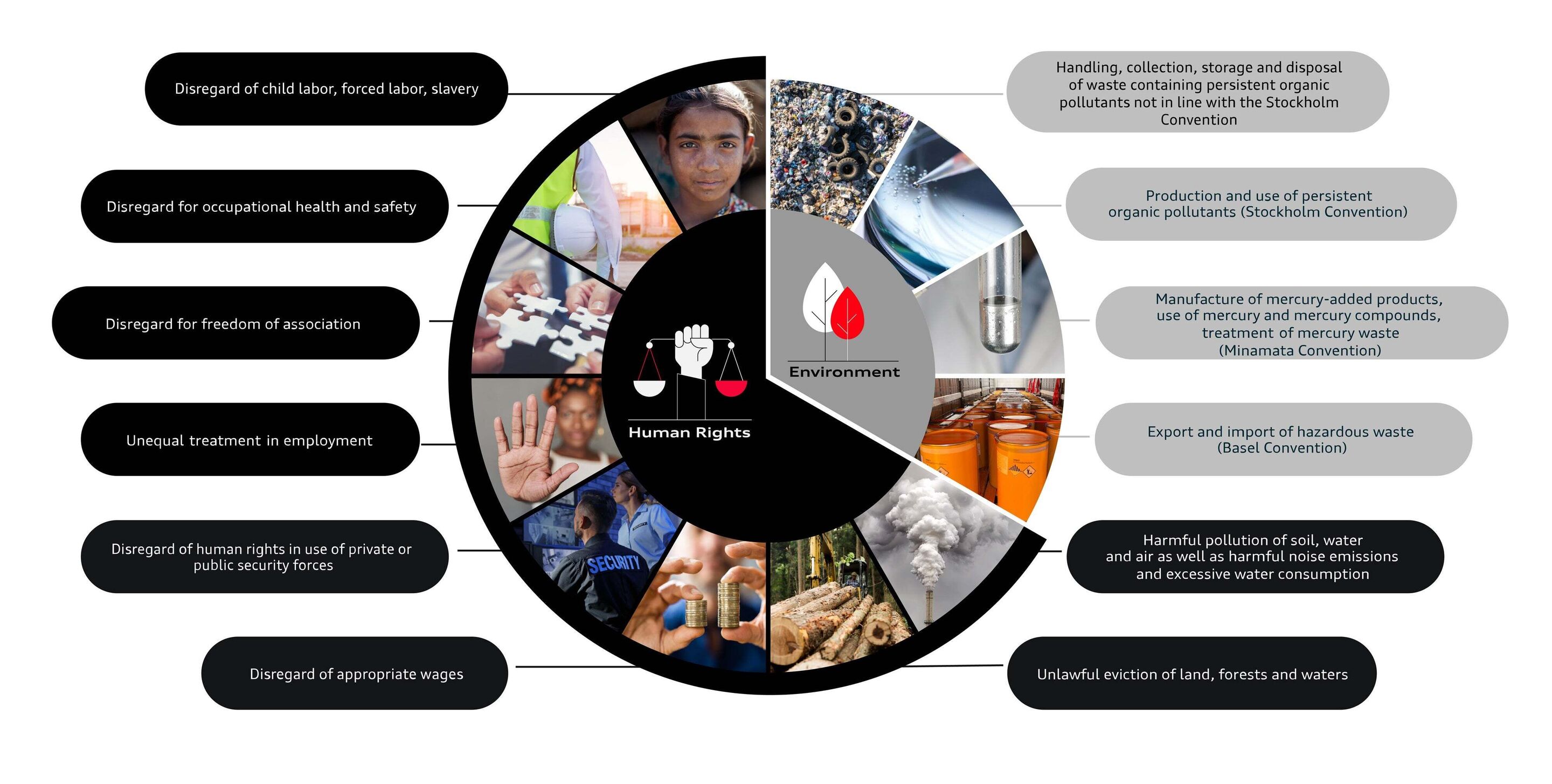
Specific implementation of human rights
AUDI AG has embedded its expectations of employees and business partners in its binding Audi Code of Conduct and Volkswagen Code of Conduct for Business Partners, published them and generally made them a fixed component of contracts governing business relationships. Numerous internal policies specify these goals and expectations in the Audi sphere of activity in greater detail. The company actively communicates these and carries out regular training measures for employees, in particular managers, and supplier companies.
To fulfill its human rights due diligence obligations, Audi has established a multi-level risk management system that focuses both inward at the company itself as well as outward at the supply chain and at the impact of Audi activities on people and the environment. Audi identifies, analyzes and prioritizes human rights and environment-related risks and derives preventive or remedial measures from them. This is carried out at least once a year or on an ad hoc basis whenever there is the need to take appropriate action to tackle newly emerging risks or incidents.
The risk-based approach makes it possible to target resources where the likelihood and potential severity of adverse impacts are particularly high.
Stakeholder dialogue and change of perspective
Engagement with external stakeholders is an important element of Audi’s human rights due diligence. External perspectives help Audi to better understand risks, identify the expectations of relevant stakeholder groups at an early stage and critically assess the effectiveness of existing measures.
The company therefore regularly invites experts from business, academic and scientific communities, associations, trade unions and nongovernmental organizations (NGOs) to dialogue events. This form of open exchange with various stakeholders contributes to an even better understanding of specific issued in the context of human rights and to the development and implementation of approaches that can lead to structural change.
Audi is a member of the Sector Dialogue Automotive Industry of the Global Compact Network Germany. In this multi‑stakeholder forum, representatives from companies, trade unions, associations, civil society and the German Federal Government have come together to jointly address structural challenges and to discuss and further develop approaches to strengthening human rights due diligence obligations in global supply and value chains within the German automotive industry.
Other approaches to human rights work include a “Human Rights Expert Group” established by the Human Rights Officer. The Human Rights Expert Group regularly draws on external expertise from academia, business and international institutions, and supports Audi in further developing its human rights strategy and assessing current developments. The Expert Group’s input contributes to the continuous development of the human rights strategy and its implementation.